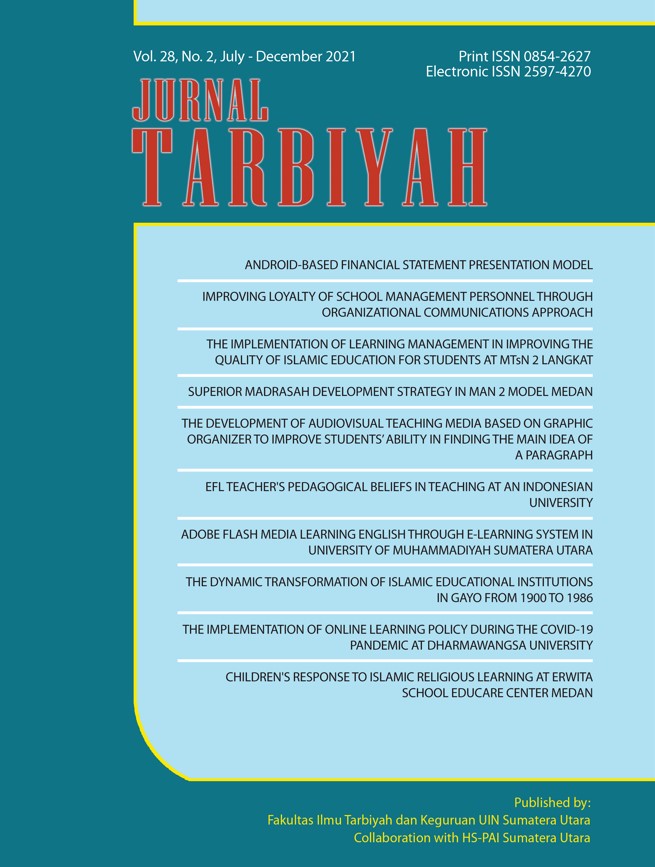
ADOBE FLASH MEDIA LEARNING ENGLISH THROUGH E-LEARNING SYSTEM IN UNIVERSITY OF MUHAMMADIYAH SUMATERA UTARA
DOI:
https://doi.org/10.30829/tar.v28i2.1137Abstract
The Objective of study is to find the result of the learning process of Adobe Flash as media on the course of Pengembangan Media Pembelajaran through E-Learning system at English education study program in University of Muhammadiyah Sumatera Utara. E-learning provides a set of tools to enrich the value of conventional learning model, studies of textbooks, CD-ROMs, and computer-based training. Students can answer the challenges of globalization. Research Method used descriptive method through qualitative approach. Method of research conducted qualitative. Sample of research were forth semester students of English education study program. E learning system of UMSU provided schedule of course, attendance check, discussion forum between a lecture and students, task file, exercises file integrated Moodle and google form, module e book of Pengembangan Media Pembelajaran, slide file presentation, all activities viewed past, present and future time. Adobe flash media learning English implemented by virtual for one semester. The students can be active teaching English using Adobe Flash, simple material for presentation. They were enthusiastic when learn Adobe flash as media leaning English.References
Aripin, Ipin. (2018). Konsep Dan Aplikasi Mobile Learning Dalam Pembelajaran Biologi.
Jurnal Bio Educatio, Volume 3. Nomor 1
Asmi, Adhitya Rol.,& Aulia Novemy Dhita Surbakti.,& Yunani Hasan.,& Syarifuddin. (2019). Pengembangan Model Mobile Learning Berbasis Aplikasi Android pada Mata Kuliah Sejarah ASEAN. Jurnal Pendidikan dan Sejarah. Vol. 5, No. 1. E-ISSN: 2477-8214
Ally, Mohamed.,& Avgoustos Tsinakos. (2014). Perspectives On Open And Distance Learning: Increasing Access Through Mobile Learning. Canada: COL. ISBN 978-1-894975-64-3
Darmawan, Dr. Deni. (2016). Mobile Learning: Sebuah Aplikasi Teknologi Pembelajaran.
Jakarta: Grafindo. ISBN 978 979 769 944 4
Dwiyogo, Dr. Wasis D. (2018). Pembelajaran Berbasis Blended Learning. Depok: Rajawali Pers. ISBN 978 602 425 328 8
Hapidz, Radif A.,& Kamin Sumardi.,& Mumu Komaro. (2019). Desain Dan Pembuatan Media Pembelajaran Mobile Learning Pada Mata Pelajaran Sistem Dan Instalasi Tata Udara. Journal of Mechanical Engineering Education. Vol. 6. No. 1.
Kukulska-Hume, Agnes.,& Jhon Traxler. (2005) Mobile Learning: A Handbook for educator and trainers. New York: Routledge. ISBN: 0 415 35739 X
.,& Olga Viberg. (2018). Mobile collaborative language learning: State of the art. British Journal of Educational Technology. Vol 49 No 2
Kurniawan, M Arif.,& Agus Miftahillah.,& Nilna Milhatan Nasihah. (2018). Pembelajaran Berbasis Student-Centered Learning Di Perguruan Tinggi: Suatu Tinjauan di UIN Sunan Kalijaga Yogyakarta. Lentera pendidikan. Vol. 21 2 no. 1
Siregar, Alfitriani. (2018) Pendidikan Tinggi Di Era Revolusi Industri 4.0: Model Pembelajaran E-Learning Pada Universitas Muhammadiyah Sumatera Utara. Prosiding Konferensi Nasional Ke- 8 Asosiasi Program Pascasarjana Perguruan Tinggi Muhammadiyah (APPPTMA). ISBN: 978-623-90018-1-0
(2020) M-Learning Device: Using Video To Improve Students’ Writing Skill. Journal of English Teaching and Linguistics. Vol 1. No 1. ISSN: 2723- 0961 https://ejournal.unida-aceh.ac.id/index.php/jetli
Sutrisno, Prof.Dr. (2016) Desain Kurikulum Perguruan Tinggi: Mengacu KKNI. Bandung: Rosda. ISBN 978 979 692 707 4
Zahroni, Ardhian. (2019). Pengembangan Mobile Learning Menggunakan Adobe Flash Pada Pelajaran Narrative Text Di Smp Elkisi Mojokerto. Jurnal Manajemen Pendidikan Islam. Vol 4 No 1. Hal: 90-103. ISSN: 2503-1481
Downloads
Published
Issue
Section
License
Authors who publish with this journal agree to the following terms:
Authors are able to enter into separate, additional contractual arrangements for the non-exclusive distribution of the journal's published version of the work (e.g., post it to an institutional repository or publish it in a book), with an acknowledgement of its initial publication in this journal.
Authors are permitted and encouraged to post their work online (e.g., in institutional repositories or on their website) prior to and during the submission process, as it can lead to productive exchanges, as well as earlier and greater citation of published work (See The Effect of Open Access).
Jurnal Tarbiyah provides immediate open access to its content on the principle that making research freely available to the public supports a greater global exchange of knowledge. Jurnal Tarbiyah Open Access articles are distributed under this CC BY SA.