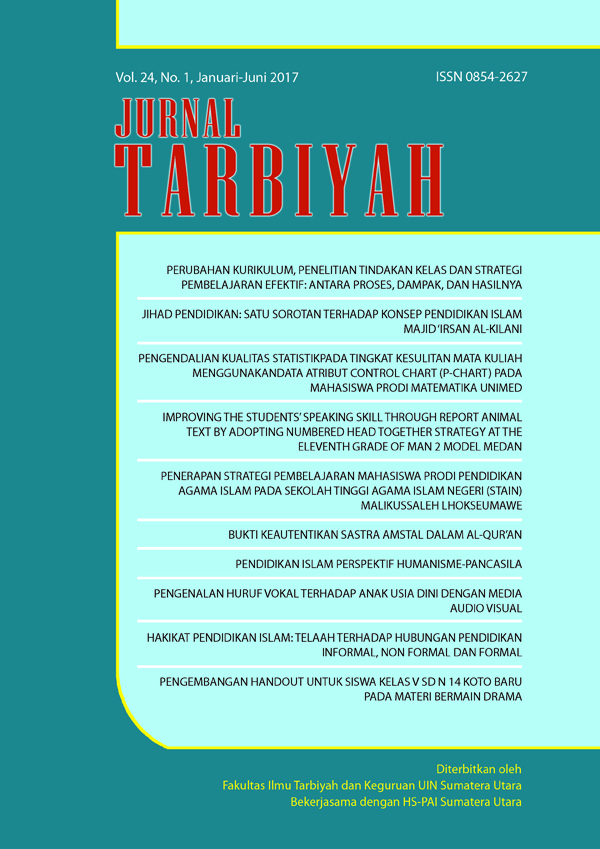
BUKTI KEAUTENTIKAN SASTRA AMSTAL DALAM AL-QUR’AN
DOI:
https://doi.org/10.30829/tar.v24i1.128Abstract
The Qur'an is the holy book of life of mankind which has a high miracle. Miracles of the Qur'an in a variety of fields such as language style (mubalaghah, Ma'ani, and badi ') has the advantages that no one can beat. This discussion tries to give a brief overview of the evidence in the Qur'an's authenticity amstal literature. The method proposed is a method in the interpretation of thematic approaches that address specific themes taken from the piece of it. Alquan Qur'an as a guide to human life have drawn style and express and implied meanings are difficult to interpret without an established science. This case which led to the authenticity of the book are maintained and paradigms of human hands that want to imitate or emulate even a single verse.Keywords: Literature, Quran, and AmstalReferences
Abdurrahman, Emose, dan Ranoedarsono, Apriyanto, The Amaging Stories of
Alquran Sejarah yang Harus dibaca, Bandung: Salamadani, 2009
Al-Qathatahn, Syaikh Manna, Mabahis fi ‘Ulumil Qura’an, Ter. Aunnur Rafiq El-
Mazni, Pengantar Studi Ilmu Al-Qur’an, Jakarta: Purtaka Al-Kautsar, 2009 .
Ash Shiddieqy, M. Muhammad Hasbi, Ilmu-ilmu AlQur-an Media-media Pokok
Dalam Manfasirkan Al Qur-an, Jakarta: Bulan Bintang, cet. I, 1972
Asyuyuthi, Jalamuddin Abdurrahman Ibn Bakri, Itqan fii ‘Ulumil Qur’an, Bairut:
Darul ‘Ilmi, 1416.
Daud Ali, Mohammad, Pendidikan Agama Islam, Jakarta: Raja Grafindo Persada,
http://digilib.uin-suka.ac.id
Khalil al-Qattan, Syaikh Manna, Mabahis fi ‘Ulumil Quran, Terj. Mudzakir AS.,
Studi Ilmu-ilmu Qur’an, Jakarta: PT. Mitra Kerjaya Indonesia, 2004
Muhammadi Ali Ash Shobuni, Syaikh, Ikhtisar Ulumul Qur’an Praktis Terj.
Muhammad Nur, Jakarta: Pustaka Amani, 1988
Downloads
Published
Issue
Section
License
Authors who publish with this journal agree to the following terms:
Authors are able to enter into separate, additional contractual arrangements for the non-exclusive distribution of the journal's published version of the work (e.g., post it to an institutional repository or publish it in a book), with an acknowledgement of its initial publication in this journal.
Authors are permitted and encouraged to post their work online (e.g., in institutional repositories or on their website) prior to and during the submission process, as it can lead to productive exchanges, as well as earlier and greater citation of published work (See The Effect of Open Access).
Jurnal Tarbiyah provides immediate open access to its content on the principle that making research freely available to the public supports a greater global exchange of knowledge. Jurnal Tarbiyah Open Access articles are distributed under this CC BY SA.