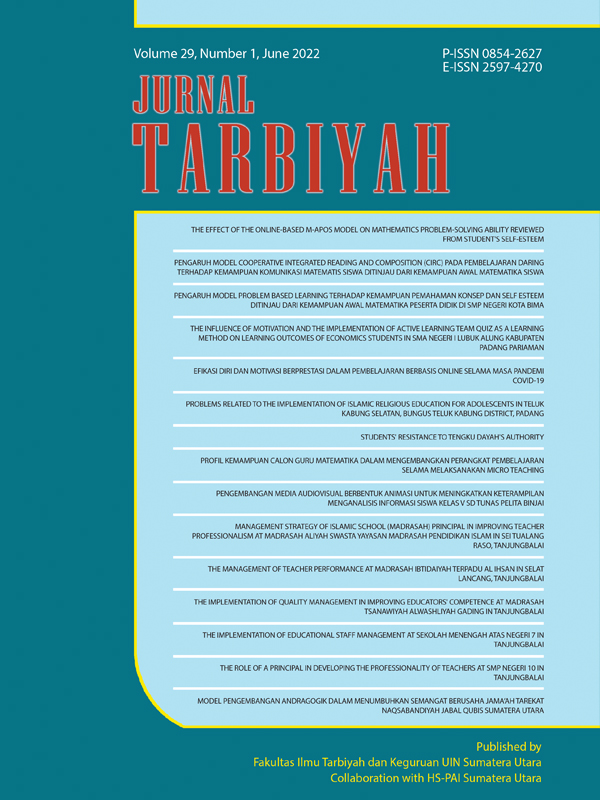
PROFIL KEMAMPUAN CALON GURU MATEMATIKA DALAM MENGEMBANGKAN PERANGKAT PEMBELAJARAN SELAMA MELAKSANAKAN MICRO TEACHING
DOI:
https://doi.org/10.30829/tar.v29i1.1367Abstract
This study aims to describe the ability of prospective mathematics teachers in developing lesson plans during micro teaching activities. This study is a qualitative descriptive research equipped with quantitative data used to explain the findings that exist before the results of the study concluded in qualitative form. To obtain the data, the researchers conducted observations and assessments using assessment instrument sheets based on Permendikbud number 22 of 2016 against the lesson plan prepared by 34 prospective mathematics teachers UIN North Sumatra Medan during micro teaching activities and interviews. Assessment of the lesson plan is done by giving a score on each aspect of the component with a scale assessment of 3 that is fully appropriate, partially appropriate, and not appropriate. The assessment score of each RPP component is processed by descriptive statistics and then categorized according to quantitative data classification and converted into qualitative data of three categories, namely high, medium, and low categories. The results of this study indicate that the ability of prospective teachers of mathematics in preparing all components of the lesson plan reached a high category except on one component.References
Aryani, M. F. (2014). Studi Kasus Penerapan Pendekatan Saintifik Pada Guru-Guru Di Sma N 1 Bawang (Studi Pada Tahun Ajaran 2013/2014). Economic Education Analysis Journal, 3(3), 558–563.
Asmadawati. (2014). Perencanaan Pengajaran. Jurnal Darul ‘Ilmi, 02(01), 1–13.
Asropah, A., Sulanjari, B., & Alfiah, A. (2019). Kemampuan Menyusun Rencana Pelaksanaan Pembelajaran (RPP) Kurikulum 2013 Revisi 2017 Guru Bahasa Jawa Sekolah Menengah Atas (SMA) Kota Semarang. Media Penelitian Pendidikan : Jurnal Penelitian Dalam Bidang Pendidikan Dan Pengajaran, 11(2), 26–36. https://doi.org/10.26877/mpp.v11i2.3360
Azwar, S. (2015). Tes prestasi: Fungsi dan pengembangan pengukuran prestasi belajar. Pustaka Pelajar Offset.
Bariyah, L., Budiono, J. D., & Rahayu, Y. S. (2014). Analisis Kesesuaian Rpp Dan Pelaksanaan Pembelajaran Guru Smpn Di Kabupaten Mojokerto Pada Sub Materi Fotosintesis Dengan Kerikulum 2013 the Analysis of Suitability of Lesson Plan and Learning Process the Teacher Developed of Junior High Schools in Mojoke. 3(3), 453–460.
Chusni, M. M., Setya, W., Agustina, R. D., & Malik, A. (2017). Peningkatan Kemampuan Menyusun Rencana Pelaksanaan Pembelajaran (RPP) Berbasis Saintifik bagi Calon Guru Fisika. Scientiae Educatia, 6(2), 125–143. https://doi.org/10.24235/sc.educatia.v6i2.1952
Dewi, R. P., & Krismawati, S. (2018). Kemampuan menyusun perangkat rencana pelaksanaan pembelajaran mahasiswa program studi pendidikan bahasa dan sastra indonesia angkatan 2014 …. Pertemuan Ilmiah Bahasa Dan Sastra Indonesia, 633, 633–648. https://repository.usd.ac.id/33575/1/5121_PIBSI+Rishe+dan+Septi+2018.pdf
Fitriyah, L. A., & Hayati, N. (2020). Analisis Keterampilan Menyusun Rpp Mahasiswa Calon Guru Ipa Menggunakan Active Learning. LENSA (Lentera Sains): Jurnal Pendidikan IPA, 10(2), 83–93. https://doi.org/10.24929/lensa.v10i2.117
Herviani, D., & Budiastuti, R. E. (2018). Analisis Rencana Pelaksanaan Pembelajaran ( RPP ) Bahasa Inggris Mahasiswa Magang di SMA Negeri 9 Semarang. Journal of E-ISSN, 1(2), 486–491.
Kemendikbud. (2016). Peraturan Menteri Pendidikan Dan Kebudayaan Nomor 22 Tahun 2016 Tentang Standar Proses Pendidikan Dasar Dan Menengah.
Kurniasih, I., & Sari, B. (2014). Perancangan Pembelajaran Prosedur Pembuatan RPP (Rencana Pelaksanaan Pembelajaran). Kata Pena.
Lantik, V., Supu, A., Fakhruddin, Yusuf, Y. H. M., Astiti, K. A., & Hali, A. S. (2021). Analisis Kemampuan Menyusun Rpp Berbasis Saintifik Mahasiswa Calon Guru Fisika. OPTIKA: Jurnal Pendidikan Fisika, 5(1), 34–44.
Mager, R. F. (1973). Measuring instructional intent. Fearon Pitman Publishers.
Mawardi, M. (2019). Optimalisasi Kompetensi Guru Dalam Penyusunan Rencana Pelaksanaan Pembelajaran. JURNAL ILMIAH DIDAKTIKA: Media Ilmiah Pendidikan Dan Pengajaran, 20(1), 69. https://doi.org/10.22373/jid.v20i1.3859
Napitupulu, N. D. (2014). Analisis Kompetensi Mahasiswa Calon Guru Fisika Pada Peer Teaching Berdasarkan Kurikulum 2013 Pada Perkuliahan PPL. JPFT (Jurnal Pendidikan Fisika Tadulako Online), 2(2), 23–28. https://doi.org/10.22487/j25805924.2014.v2.i2.2853
Putra, I. A., & Pertiwi, N. A. S. (2019). Keterampilan Mahasiswa Prodi Pendidikan Fisika dalam Merancang Perangkat Pembelajaran Fisika pada Kurikulum 2013. Journal of Educatio and Management Studies, 2(4), 41–46.
Sukmawati, R. (2019). Analisis kesiapan mahasiswa menjadi calon guru profesional berdasarkan standar kompetensi pendidik. Jurnal Analisa, 5(1), 95–102. https://doi.org/10.15575/ja.v5i1.4789
Yenni, Y. (2017). Analisis Kemampuan Mahasiswa Dalam Menyiapkan Pembelajaran Yang Efektif Pada Mata Kuliah Sbmm. Jurnal Penelitian Dan Pembelajaran Matematika, 10(2). https://doi.org/10.30870/jppm.v10i2.2038
Zendrato, J. (2016). Tingkat Penerapan Rencana Pelaksanaan Pembelajaran Dalam Pelaksanaan Pembelajaran Di Kelas: Suatu Studi Kasus di SMA Dian Harapan Jakarta. Scholaria : Jurnal Pendidikan Dan Kebudayaan, 6(2), 58–73. https://doi.org/10.24246/j.scholaria.2016.v6.i2.p58-73
Downloads
Published
Issue
Section
License
Authors who publish with this journal agree to the following terms:
Authors are able to enter into separate, additional contractual arrangements for the non-exclusive distribution of the journal's published version of the work (e.g., post it to an institutional repository or publish it in a book), with an acknowledgement of its initial publication in this journal.
Authors are permitted and encouraged to post their work online (e.g., in institutional repositories or on their website) prior to and during the submission process, as it can lead to productive exchanges, as well as earlier and greater citation of published work (See The Effect of Open Access).
Jurnal Tarbiyah provides immediate open access to its content on the principle that making research freely available to the public supports a greater global exchange of knowledge. Jurnal Tarbiyah Open Access articles are distributed under this CC BY SA.