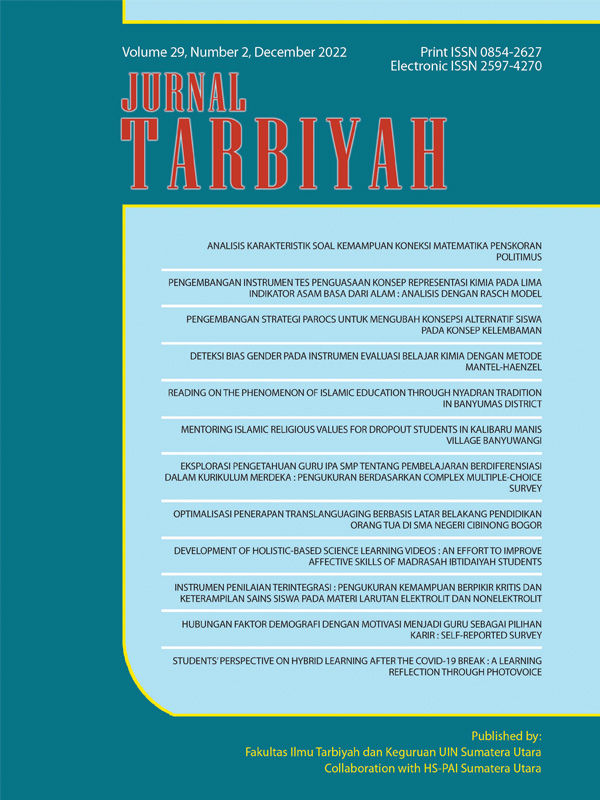
PENGEMBANGAN STRATEGI PAROCS UNTUK MENGUBAH KONSEPSI ALTERNATIF SISWA PADA KONSEP KELEMBAMAN
DOI:
https://doi.org/10.30829/tar.v29i2.1758Abstract
The aim of this study was to develop a Prediction, Alternative conceptions, Refutation, Observation, Comparison and Scientific explanation (PAROCS) strategy to change students’ alternative concepts on inertia concept. The research method used is the 4D model (Define, Design, Develop and Disseminate). Participants were 30 students (15 boys and 15 girls, their average age were 15-16) in class X of a public high school in Sukabumi, West Java. The instrument used is a four-tier diagnostic test. Data were analyzed based on a 4D model and conceptual category. At the disseminate stage, it shows an increase in scientific concepts and a decrease in alternative concepts after the application of the PAROCS strategy. From this, it can conclude that PAROCS strategy can be developed to change students’ alternative concepts into scientific concepts. Further studies could not only use the PAROCS strategy, but also develop this strategy for different physics concepts.References
Ayvaci, H. Ş. (2013). Investigating the effectiveness of predict-observe- explain strategy on teaching photo electricity topic. Journal of Baltic Science Education, 12(5). https://doi.org/10.33225/jbse/13.12.548
Baydere, F. K. (2021). Effects of a context-based approach with prediction-observation-explanation on conceptual understanding of the states of matter, heat and temperature. Chemistry Education Research and Practice, 22(3), 640–652. https://doi.org/10.1039/d0rp00348d
Berek, F. X., Sutopo, S., & Munzil, M. (2016). Concept enhancement of junior high school students in hydrostatic pressure and archimedes law by predict-observe-explain strategy. Jurnal Pendidikan IPA Indonesia, 5(2), 230–238. https://doi.org/10.15294/jpii.v5i2.6038
Braasch, J. L. G., Goldman, S. R., & Wiley, J. (2013). Influences of text and reader characteristics on learning from refutations in science texts. Journal of Educational Psychology, 105(3), 561–578. https://doi.org/10.1037/a0032627
Çil, E., & Çepni, S. (2015). The effectiveness of conceptual change texts and concept clipboards in learning the nature of science. 5143(December). https://doi.org/10.1080/02635143.2015.1066323
Fratiwi, N. J., Samsudin, A., Ramalis, T. R., & Costu, B. (2020). Changing students’ conceptions of Newton’s second law through express-refute-investigate-clarify (ERIC) text. Universal Journal of Educational Research, 8(6), 2701–2709. https://doi.org/10.13189/ujer.2020.080655
Gómez, P. J. S. (2021). On the Epistemic Value of Students’ Conceptions in Science Education. Science and Education, 30(4), 827–847. https://doi.org/10.1007/s11191-021-00211-4
Gurel, D. K., Eryilmaz, A., & McDermott, L. C. (2015). A review and comparison of diagnostic instruments to identify students’ misconceptions in science. Eurasia Journal of Mathematics, Science and Technology Education, 11(5), 989–1008. https://doi.org/10.12973/eurasia.2015.1369a
Halim, L., Yong, T. K., & Meerah, T. S. M. (2014). Overcoming Students’ Misconceptions on Forces in Equilibrium: An Action Research Study. Creative Education, 05(11). https://doi.org/10.4236/ce.2014.511117
Harrell, P. E., Kirby, B., Subramaniam, K., & Long, C. (2022). Are Elementary Preservice Teachers Floating or Sinking in Their Understanding of Buoyancy? International Journal of Science and Mathematics Education, 20(2). https://doi.org/10.1007/s10763-021-10160-7
Irmak, M., Inaltun, H., Ercan-Dursun, J., Yaniş-Kelleci, H., & Yürük, N. (2022). Development and Application of a Three-Tier Diagnostic Test to Assess Pre-service Science Teachers’ Understanding on Work-Power and Energy Concepts. International Journal of Science and Mathematics Education. https://doi.org/10.1007/s10763-021-10242-6
Jasdilla, L., Fitria, Y., & Sopandi, W. (2019). Predict Observe Explain (POE) strategy toward mental model of primary students. Journal of Physics: Conference Series. https://doi.org/10.1088/1742-6596/1157/2/022043
Jiang, T., Wang, S., Wang, J., & Ma, Y. (2018). Effect of different instructional methods on students’ conceptual change regarding electrical resistance as viewed from a synthesized theoretical framework. Eurasia Journal of Mathematics, Science and Technology Education, 14(7), 2771–2786. https://doi.org/10.29333/ejmste/90592
Kaya, Z., Kaya, O. N., Aydemir, S., & Ebenezer, J. (2022). Knowledge of Student Learning Difficulties as a Plausible Conceptual Change Pathway Between Content Knowledge and Pedagogical Content Knowledge. Research in Science Education, 52(2). https://doi.org/10.1007/s11165-020-09971-5
Küchemann, S., Klein, P., Fouckhardt, H., Gröber, S., & Kuhn, J. (2020). Students’ understanding of non-inertial frames of reference. Physical Review Physics Education Research, 16(1). https://doi.org/10.1103/PhysRevPhysEducRes.16.010112
Liu, G., & Fang, N. (2016). Student misconceptions about force and acceleration in physics and engineering mechanics education. International Journal of Engineering Education, 32(1), 19–29.
Majid, A., & Suyono, S. (2018). Misconception Analysis Based On Students Mental Model In Atom Structure Materials. https://doi.org/10.2991/snk-18.2018.53
Mason, L. (2018). The Role of Inhibition in Conceptual Learning from Refutational and Standard Expository Texts. International Journal of Science and Mathematics Education, 17(3), 483–501. https://doi.org/https://doi.org/10.1007/s10763-017-9874-7
Ozkan, G., & Selcuk, G. S. (2015). Effect of Technology Enhanced Conceptual Change Texts on Students’ Understanding of Buoyant Force. Universal Journal of Educational Research, 3(12), 981–988. https://doi.org/10.13189/ujer.2015.031205
Ozkan, G., & Selcuk, G. S. (2016). Facilitating conceptual change in students’ understanding of concepts related to pressure. European Journal of Physics, 37(5). https://doi.org/10.1088/0143-0807/37/5/055702
Podschuweit, S., & Bernholt, S. (2018). Composition-Effects of Context-based Learning Opportunities on Students’ Understanding of Energy. Research in Science Education, 48(4). https://doi.org/10.1007/s11165-016-9585-z
Samsudin, A., Azura, Kaniawati, I., Suhandi, A., Fratiwi, N. J., Supriyatman, Wibowo, F. C., Malik, A., & Costu, B. (2019). Unveiling students’ misconceptions through computer simulation-based PDEODE learning strategy on dynamic electricity. Journal of Physics: Conference Series, 1280(5), 1–8. https://doi.org/10.1088/1742-6596/1280/5/052050
Samsudin, Achmad, Suhandi, A., Rusdiana, D., Kaniawati, I., & Costu, B. (2015). Fields Conceptual Change Inventory: a Diagnostic Test Instrument on the Electric Field and Magnetic Field To Diagnose Students’ Conceptions. International Journal of Industrial Electronics and Electrical Engineering, 3(12), 74–77.
Samsudin, Achmad, Suhandi, A., Rusdiana, D., Kaniawati, I., & Coştu, B. (2017). Promoting conceptual understanding on magnetic field concept through interactive conceptual instruction (ICI) with PDEODE∗E tasks. Advanced Science Letters, 23(2), 1205–1209. https://doi.org/10.1166/asl.2017.7539
Suhandi, A., Hermita, N., Samsudin, A., Maftuh, B., & Coştu, B. (2017). Effectiveness of visual multimedia supported conceptual change texts on overcoming students’ misconception about boiling concept. Turkish Online Journal of Educational Technology, 1012–1022.
Will, K. K., Masad, A., Vlach, H. A., & Kendeou, P. (2019). The effects of refutation texts on generating explanations. Learning and Individual Differences, 69, 108–115. https://doi.org/10.1016/j.lindif.2018.12.002
Yürük, N., & Eroğlu, P. (2016). The effect of conceptual change texts enriched with metaconceptual processes on pre-service science teachers’ conceptual understanding of heat and temperature. Journal of Baltic Science Education, 15(6), 693–705.
Downloads
Published
Issue
Section
License
Authors who publish with this journal agree to the following terms:
Authors are able to enter into separate, additional contractual arrangements for the non-exclusive distribution of the journal's published version of the work (e.g., post it to an institutional repository or publish it in a book), with an acknowledgement of its initial publication in this journal.
Authors are permitted and encouraged to post their work online (e.g., in institutional repositories or on their website) prior to and during the submission process, as it can lead to productive exchanges, as well as earlier and greater citation of published work (See The Effect of Open Access).
Jurnal Tarbiyah provides immediate open access to its content on the principle that making research freely available to the public supports a greater global exchange of knowledge. Jurnal Tarbiyah Open Access articles are distributed under this CC BY SA.