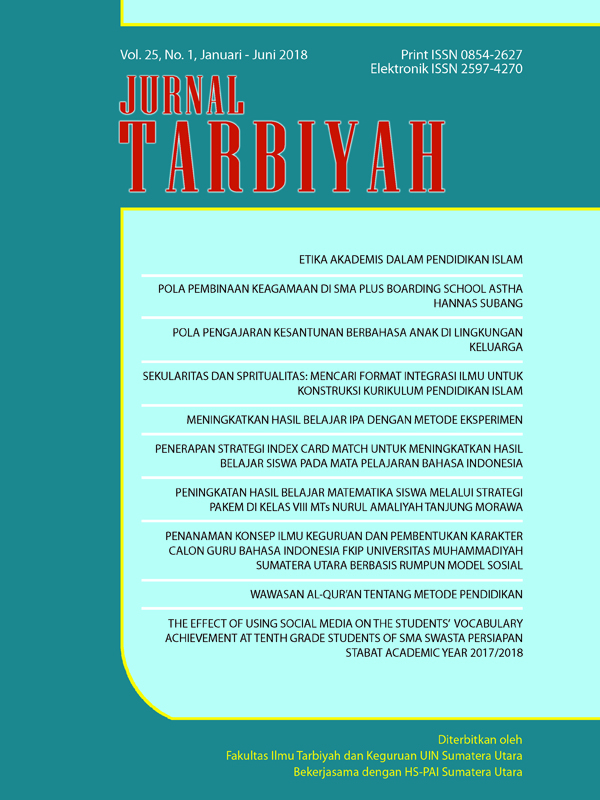
Pola Pengajaran Kesantunan Berbahasa Anak Di Lingkungan Keluarga
DOI:
https://doi.org/10.30829/tar.v25i1.238Abstract
This research was about parents way in teaching politeness in their environment. The objectives of this research were (1) to examine parents’ perception about teaching language politeness to their children in a family environment;(2) to describe what patterns are implemented by parents in teaching language politeness to the children;(3) to find out the forms of language politeness taught to the children and (4) to describe the obstacles encountered by parents when they taught their children language politeness.Descriptive qualitative design was used in this research. The data were obtained by doing the interview and observation to the objects of research. The result revealed that all parents agreed about teaching language politeness to their children in a familay environment based on some reasons.First, famliy is the first place for children to learn about politeness. Second, teaching language politeness to children is one way to maintain our culture and third, teaching language politeness to the children can make them far from the dispute. Teaching language politeness to the children must be done through refraction, instruction, control, and modelling.References
Astuti, Sri Puji. Kesantunan Berbahasa di Lingkungan Rumah Tangga.eprints.undip.ac.id/..
Cresswell, John.W. 2009.ResearchDesign; Qualitative, Quantitative, and Mixed Methods Approaches.Singapore: SAGE
Hardiyanto, Fahrudin Eko Hardiyanto.Pelanggaran kesantunan Berbahasa Anak-Anak SMP dalam Berinteraksi di Luar Kelas dengan Guru dan Teman Sebaya (Kajian Sosiopragmatik pada Siswa SD-SMP Satu Atap Rogoselo): Jurnal Ilmiah Cendekia
Haryanti, Kasdi. 2015. Berbahasa Santun Bermula dari Keteladanan. http://keterampilanberbicara.blogspot.co.id
Indrariani , Eva Ardiana dan Nayla, zzah.2015. IBM Prinsip Kesantunan Berbahasa Indonesia Sebagi Wujud Pembelajaran Etika Percakapan Anak bagi Ibu-Ibu PKK Magarsari Margoyoso Jepara download.portalgaruda.org/article.
Leech.G 2014. The Pragmatics of Politeness. Oxford: Oxford University Press
Leech.G 1993. Prinsip-Prinsip Pragmatik. Penterjemah. MD. D. Oka. Jakarta: Universitas Indonesia.
Latifah, Melly . 2001. Peranan Keluarga dalam Pendidikan Karakter Anak Makalah. Diunduh dari http://indo2.islamic-world.net
Megawangi, Ratna. 2010. Pengembangan Program Pendidikan Karakter di Sekolah; Pengalaman Sekolah Karater. Makalah IHF. Jakarta
Sutiyono.2013. Peran Sekolah dan Keluarga dalam Membentuk Karakter Siswa. http://www.ekolahdasar.net/2013/07peranan-sekolah-dan-keluarga-dalam-membentuk-karakter-siswa.html#ixzz4B3N7Ypeu
Suprihatin. 2014 . Pembelajaran Kesantuan Berbahasa untuk Penanaman Pendidikan Karakter bagi Siswa di SMP . Tesis Program Pascasarjana Universitas Muhammadiyah Surakarta
Tarigan, Henry Guntur. 1986. Pengajaran Pragmatik. Bandung: Angkasa
Ulum, Uyung Amilul. 2015 Kesantunan Berbahasa Pelajar dalam Berinteraksi dengan Teman dan Guru dalam Proses Pembelajaran di dalam Kelas http://www.smkn1pandeglang.sch.id/info-78-kesantunan-berbahasa.html
Wardaya, Cep Unang. Pengembangan Pendidikan Karakter Anak Usia Dini dalam keluarga. http://www.tkplb.org/index.php/11-warta/73-pengembangan-pendidikan-karakter-anak-usia-dini-dalam-keluarga
Downloads
Published
Issue
Section
License
Authors who publish with this journal agree to the following terms:
Authors are able to enter into separate, additional contractual arrangements for the non-exclusive distribution of the journal's published version of the work (e.g., post it to an institutional repository or publish it in a book), with an acknowledgement of its initial publication in this journal.
Authors are permitted and encouraged to post their work online (e.g., in institutional repositories or on their website) prior to and during the submission process, as it can lead to productive exchanges, as well as earlier and greater citation of published work (See The Effect of Open Access).
Jurnal Tarbiyah provides immediate open access to its content on the principle that making research freely available to the public supports a greater global exchange of knowledge. Jurnal Tarbiyah Open Access articles are distributed under this CC BY SA.