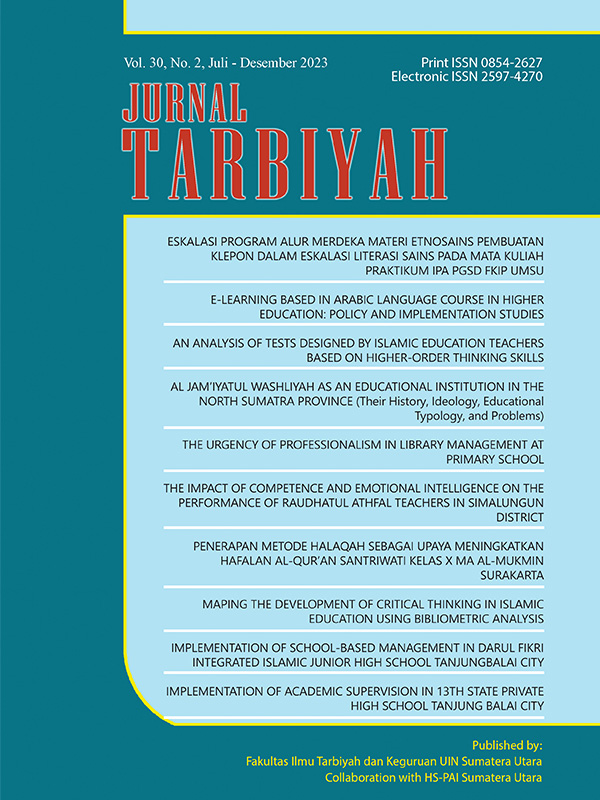
E-LEARNING BASED IN ARABIC LANGUAGE COURSE IN HIGHER EDUCATION: POLICY AND IMPLEMENTATION STUDIES
DOI:
https://doi.org/10.30829/tar.v30i2.2921Abstract
Regulatively, Universitas Islam Negeri Sumatera Utara Medan already has a number of policies related to the use of E-Learning in this university. However, the number of E-Learning classes on the E-Learning page of Universitas Islam Negeri Sumatera Utara Medan is not directly proportional to the number of lecturers and courses, including Arabic language courses in the Arabic Language Education study programme at the Faculty of Tarbiyah and Keguruan Sciences. The purpose of this study is to describe the policy of using E-Learning and its implementation in learning Arabic sciences in the Arabic Language Education study programme at the State Islamic University of North Sumatra Medan. The research approach used is qualitative with descriptive method. Data was collected using literature study, documentation, and observation. The research data analysis was carried out in three stages, namely: Data Reduction, Data Presentation, and Conclusion Drawing. Data reduction is selecting e-learning policy documents and course classes available at UIN SU Medan e-learning based on Arabic language sciences courses, so that very important, less important, and unimportant data are clustered. The data is presented in the findings and discussion related to the e-learning policy and its implementation on the UIN SU Medan e-learning page. Conclusions are drawn inductively related to the completeness of e-learning policy documents and the availability of e-learning classes in Arabic language sciences courses on the UIN SU Medan e-learning page. The results of the study show that: (1). There is a policy on the use of E-Learning at the State Islamic University of North Sumatra Medan, in the form of Rector's Decree, Rector's Circular Letter and Guidebook (2). The policy has been implemented by a number of lecturers of Arabic Language Education Study Programme, it is proven that there are a number of E-Learning classes in Arabic language courses on the UIN SU Medan E-Learning page, although the quantity is still very low, only reaching 40%. Research findings show that the use of E-Learning at UIN SU Medan is not intended to replace face-to-face lectures in the learning process, but as an additional medium to realise effective and efficient learning.References
Aidah. S. (2019). Pemanfaatan E-Learning sebagai Media Pembelajaran di STIA Al Gazali Barru (Suatu Studi terhadap Pemanfaatan Model E-Learning Berbasis Software Claroline). Meraja Journal, 2(1), 1–12. https://merajajournal.com/index.php/mrj/article/view/20/17
Asdari, A., Nisa’, M., Hady, Y., & Kasyful Anwar, A. W. (2022). Optimalisasi Pembelajaran Bahasa Arab Di Masa Covid-19 Melalui E-Learning Pada Prodi Non Bahasa Arab. Arabi : Journal of Arabic Studies, 7(1), 93–108. https://doi.org/10.24865/ajas.v7i1.457
Ayu, M. (2020). Online Learning: Leading E-Learning At Higher Education. Journal of English Literacy Education, 7(1), 47–54.
Aziz, A. (2020). Penggunaan E-Learning Sebagai Media Dalam Proses Belajar Bahasa Inggris Di Universitas Darwan Ali Sampit. Widya Wacana: Jurnal Ilmiah, 15(1), 11–17. https://doi.org/10.33061/j.w.wacana.v15i1.3514
Chandrawati, S. R. (2010). Pemamfaatan E-Learning Dalam Pembelajaran. Jurnal Cakrawala Kependidikan, 8(2), 172–181.
Elcullada Encarnacion, R., Galang, A. A., & Hallar, B. J. (2021). The Impact and Effectiveness of E-Learning on Teaching and Learning. International Journal of Computing Sciences Research, 5(1), 383–397. https://doi.org/10.25147/ijcsr.2017.001.1.47
Hadi Elyas, A. (2018). Penggunaan Model Pembelajaran E-Learning Dalam Meningkatkan Kualitas Pembelajaran. Jurnal Warta, 56(04), 1–11. https://jurnal.dharmawangsa.ac.id/index.php/juwarta/article/view/4
Hasan, Y. H., Zaini, A. R., & ... (2020). التدخل اللغوي لدى طلبة المدارس الثانوية الماليزية في مسابقة صناعة الأفلام القصيرة الناطقة بالعربية: Language interference effect among students of Malaysia …. Al-Irsyad: Journal of Islamic …. http://al-irsyad.kuis.edu.my/index.php/alirsyad/article/view/72
Kartika, Devia, Kurnia, H. (2022). Penerapan E-Learning Sebagai Media Pembelajaran Dalam Menghadapi Pandemi Covid -19. J-COSCIS : Journal of Computer Science Community Service, 2(1), 15–24.
Magdalena, I., Andriyanto, A., & Refaldi, R. R. (2020). Pemanfaatan Media Pembelajaran E-Learning Menggunakan Whatsapp sebagai Solusi di Tengah Penyebaran Covid-19 di SDN Gembong 1. As-Sabiqun, 2(2), 1–16. https://doi.org/10.36088/assabiqun.v2i2.998
Masdin. (2008). Konsep Dasar Analisis Kebijakan Pendidikan Tinggi. Shaut Al Arabiyyah, 21(XIV).
Mun’im, A., Oktafia, R., & Churrahman, T. (2020). Reward and Punishment to Motivate Performance in Islamic Perspective. Conference of Management of Islamic Education Leadership in The Era of Revolution 4.0. https://doi.org/https://doi.org/10.21070/icecrs2020375
Nasucha, M. R., Fikri, M., Rapsjani, A., Mareta, D., Puspitasari, A., & Malang, U. M. (2021). Urgensi Penerapan Prinsip Manajemen Modern pada Lembaga Pendidikan. Pandawa: Jurnal Pendidikan Dan Dakwah, 3(3), 303–317.
Pangestu, A., & Abdul Majid, N. W. (2021). Peran E-Learning Sebagai Media Pembelajaran Di Smkn 3 Kuningan. Journal Fascho in Education Conference-Proceedings, 2(1). https://doi.org/10.54626/proceedings.v2i1.107
Salam, M. Y., & Mudinilllah, A. (2022). Zoom Meet: Alternative Media for Supporting Arabic Language Learning During the Pandemic. Arabi : Journal of Arabic Studies, 7(1), 13–24. https://doi.org/10.24865/ajas.v7i1.404
Sayekti, R. dkk. (2019). Panduan E-Learning UIN Sumatera Utara. UIN Sumatear Utara.
Seli, S., Thamrin, L., & Nurdini, A. (2023). SPMI Sebagai Penjamin Total Quality Management Institusi. Jurnal Penjaminan Mutu, 9(1), 71–79. https://doi.org/http://ojs.uhnsugriwa.ac.id/index.php/JPM
Septiani, E. (2018). Pemanfaatan E-Learning Dalam Pembelajaran Bahasa dan Sastra Indonesia. Prosiding Pekan Seminar Nasional (Pesona), 92–98.
Setiawan, H., Rinamurti, M., & Augustine, M. (2021). Pengaruh Penggunaan Media E-Learning dan Transfer Pengetahuan dalam Kuliah Daring/Online Selama Pandemi Covid-19 Terhadap Kinerja Dosen Tetap Unika Musi Charitas. SAINTEK : Jurnal Ilmiah Sains Dan Teknologi Industri, 5(1), 11–20. https://doi.org/10.32524/saintek.v5i1.249
Solimando, C. (2022). E-Learning and Arabic in the Age of Covid-19: Rethinking the Learning of Vocabulary. In Altre Modernita (Issue 27, pp. 166–180). https://doi.org/10.54103/2035-7680/17884
Susanto, S. (2014). Strategi Menuju World Class University (Wcu) Pada Universitas Semarang. Jurnal Transformatika, 11(2), 86. https://doi.org/10.26623/transformatika.v11i2.100
Syarhani, S. (2022). Manajemen Pendidikan Islam, Konsep, Fungsi Dan Prinsip. Al Qalam: Jurnal Ilmiah Keagamaan Dan Kemasyarakatan, 16(6), 2007. https://doi.org/10.35931/aq.v16i6.1258
Tim Penyusun. (2022a). Buku Panduan Akademik FITK UIN SU Medan 2022/2023. UIN SU Press.
Tim Penyusun. (2022b). Buku Panduan Akademik UIN SU Medan TA. 2022-2023. UIN SU Press.
Z.A. Hasibuan dan H.B. Santoso. (2005). The use of e-learning towards new learning paradigm: case study student centered e-learning environment at Faculty of Computer Science - University of Indonesia.
Zubaidah, Kardena, A., Shalihah, S., Hodijah, O., Afrida, Y., & Safitri, L. (2021). Web-based e-learning Application for learning Arabic language. Journal of Physics: Conference Series, 1779(1), 0–9. https://doi.org/10.1088/1742-6596/1779/1/012011
Downloads
Published
Issue
Section
License
Authors who publish with this journal agree to the following terms:
Authors are able to enter into separate, additional contractual arrangements for the non-exclusive distribution of the journal's published version of the work (e.g., post it to an institutional repository or publish it in a book), with an acknowledgement of its initial publication in this journal.
Authors are permitted and encouraged to post their work online (e.g., in institutional repositories or on their website) prior to and during the submission process, as it can lead to productive exchanges, as well as earlier and greater citation of published work (See The Effect of Open Access).
Jurnal Tarbiyah provides immediate open access to its content on the principle that making research freely available to the public supports a greater global exchange of knowledge. Jurnal Tarbiyah Open Access articles are distributed under this CC BY SA.