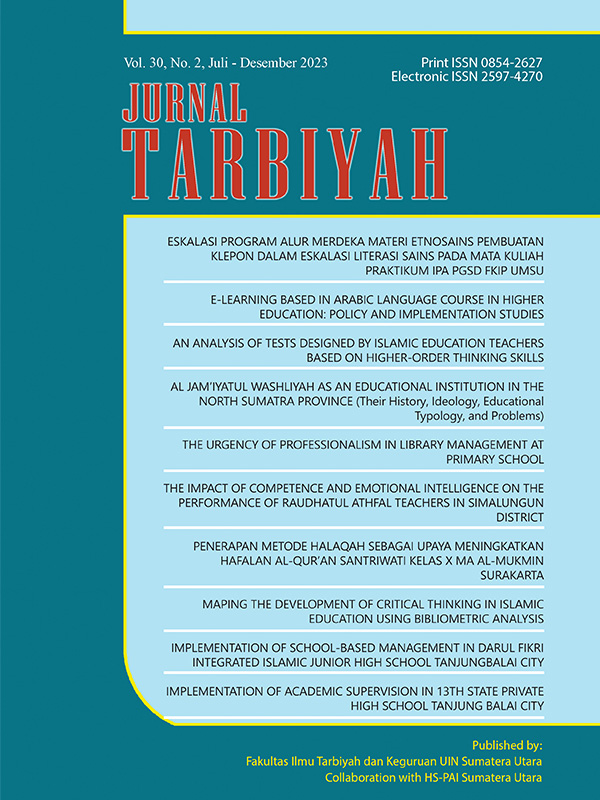
ESKALASI PROGRAM ALUR MERDEKA MATERI ETNOSAINS PEMBUATAN KLEPON DALAM ESKALASI LITERASI SAINS PADA MATA KULIAH PRAKTIKUM IPA PGSD FKIP UMSU
DOI:
https://doi.org/10.30829/tar.v30i2.2999Abstract
The background of this program evaluation is the urgent of learning loss due to Covid-19 which calls for learning to be carried out online. By this Alur Merdeka Program, it is hoped that it will be an escalation/improvement of scientific literacy in natural science practicum courses for PGSD FKIP UMSU students. The evaluation method for the Merdeka flow program in scientific literacy escalation and the evaluation results of the implementation of the Merdeka flow evaluation program in scientific literacy escalation in the Science practicum course at PGSD FKIP UMSU in terms of context, input, process, and product. The results of this study are that at the content evaluation stage an analysis of the needs of students, lecturers and learning outcomes is carried out. In the input evaluation step, the validation stage was carried out which resulted in 96.7% of the material being declared valid, 89.3% of the design being declared valid, and 84% of the language being declared valid in the development of learning tools. In the process evaluation step it was stated that in the application of the independent groove there was a change in each of the students' scientific literacy indicators in using the independent groove. students' scientific literacy in channel 1 has increased compared to pre-stream. Where in explaining the phenomenon there is an increase from an average of 75.4 to 89.23. The indicators evaluating and designing scientific investigations increased from 78.6 to 90 and the indicators interpreting data increased from an average of 75 to 91. In the final stage, namely product evaluation, it was stated that the learning tools usedReferences
Hermann M, Pentek T, Otto B. Design principles for industry 4.0 scenarios. In: 49th Hawaii International Conference on System Sciences (HICSS). 2016;(1):3928–37.
Sari M, Sitepu MS, Azizah A, ... The Effect of Offline Assisted Learning Serli Practicum Module on Solar System Materials on Student Learning Motivation. Nazhruna J … [Internet]. 2022;5(2):806–15. Available from: https://e-journal.ikhac.ac.id/index.php/NAZHRUNA/article/view/2193
Sulasmi E, Saragih M. Problem-Based Learning Approach for Elementary Schools. 2021;26:13–20.
Lendeon GR, Poluakan C. Pengaruh Model Problem Based Learning (PBL) Terhadap Kemampuan Literasi Sains Siswa. SCIENING Sci Learn J. 2022;3(1):14–21.
Agung, Prastyo ERF. Makalah Pendamping ISSN : 2830-4535 Development of Merdeka Curriculum-Based Student Worksheets for Physics Learning Phase F. 2023;1–8.
Tayibnapis AZ, Tayibnapis RG. International Journal of Multicultural and Multireligious Understanding Modernity in Hedonic Life Youth Women ( Structure of Socialite Groups Among College Students in Jakarta ). 2020;761–9.
Jaedun A, Hariyanto VL, Nuryadin, E.R. An Evaluation of the Implementation of Curriculum 2013 At the Building Construction Department of Vocational High Schoos in Yogyakarta. J Educ. 2014;7(1):14–22.
Kurniawati EW. Evaluasi Program Pendidikan Perspektif Model CIPP (Context, Input, Process, Product). J GHAITSA Islam Educ J. 2021;Volume 2(1):24.
Supriyadi S, Nurvitasari E. Inventarisasi Sains Asli Suku Malind: Upaya Dalam Pengembangan Kurikulum Ipa Kontekstual Papua Berbasis Etnosains. Edu Sains J Pendidik Sains Mat. 2019;7(1):10–20.
Asra A dan AUA. Analisis Perangkat Pembelajaran Berbasis Etnosains Di Smp Kabupaten Rokan Hulu. J Pendidik Rokania. 2021;6(1):9–22.
Mayasari T. Integrasi budaya Indonesia dengan Pendidikan Sains. Semin Nas Pendidik Fis. 2017;(2010):12–3.
Downloads
Additional Files
Published
Issue
Section
License
Authors who publish with this journal agree to the following terms:
Authors are able to enter into separate, additional contractual arrangements for the non-exclusive distribution of the journal's published version of the work (e.g., post it to an institutional repository or publish it in a book), with an acknowledgement of its initial publication in this journal.
Authors are permitted and encouraged to post their work online (e.g., in institutional repositories or on their website) prior to and during the submission process, as it can lead to productive exchanges, as well as earlier and greater citation of published work (See The Effect of Open Access).
Jurnal Tarbiyah provides immediate open access to its content on the principle that making research freely available to the public supports a greater global exchange of knowledge. Jurnal Tarbiyah Open Access articles are distributed under this CC BY SA.