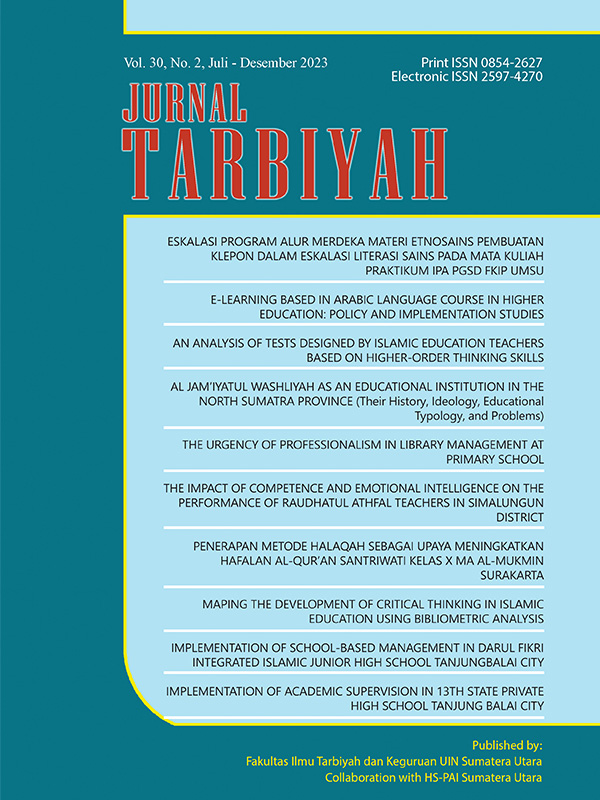
AL JAM’IYATUL WASHLIYAH AS AN EDUCATIONAL INSTITUTION IN THE NORTH SUMATRA PROVINCE (Their History, Ideology, Educational Typology, and Problems)
DOI:
https://doi.org/10.30829/tar.v30i2.3145Abstract
Al-Jam'iyatul Al Washliyah is an Islamic educational institution in Indonesia that was founded in 1952 in Medan, North Sumatra. This institution was founded by Haji Mohd Arsyad Al Banjari to spread Islamic teachings and strengthen Muslim identity in Indonesia. Al-Jam'iyatul Al Washliyah has several branches in various regions in Indonesia. Through field study with phenomenological research, Al Washliyah was founded during the Dutch colonial period to unite Muslims and fight for Indonesian independence. They have a high commitment to education, establishing schools, and madrasas, and forming the Education, Teaching and Culture Council. This research will focus on the dynamics of the Al-Washliyah educational institution in the past, present, and future so that it can show the results of intellectual exploration among Islamic scholars (Ulama) and intellectuals regarding the dynamics of Islamic education in the classical and contemporary periods in Indonesia. This research is limited to the development of the Al Jam’iyatul Washliyah Educational Institution in North Sumatra, from 2016 to 2022 in 3 Districts/Cities and history by focusing on their Ideology, Educational Typology, and Problems.References
Azizi, Ahmad Hamim, Al Jam’iyatul Washliyah dalam Kancah Politik Indonesia, Banda Aceh: PeNa, 2006.
B.J. Bolland, The Struggle of Islam in modern Indonesia (The Hague: Martinus Nijhoff: 1971)
Hasanuddin, Chalidjah (1988). Al-Jam'iyatul Washliyah 1930-1942: Api dalam Sekam di Sumatera Timur. Bandung: Penerbit Pustaka.
Ismed Batubara dan Ja’far (ed), Bunga Rampai Al Jam’iyatul Washliyah (Banda Aceh: Alwashliyah University Press, 2010).
Ja’far (ed), Al Jam’iyatul Washliyah: Potret Histori, Edukasi dan Filosofi, (Medan: Perdana Publishing dan CAS, 2011.
Karel A. Steenbrink, Pesantren, Madrasah, Sekolah: Pendidikan Islam dalam Kurun Modern (Jakarta: LP3ES, 1986), 26-8
Neliwati, Lembaga-Lembaga Pendidikan Islam di Sumatera Utara, Penerbit IAIN Press, Perdana Mulia Sarana, 2013.
Paralihan, Hotmatua, Metode dan Peranan Dakwah Al Jam’iyatul Washliyah di Sumatera Utara, Medan: PPS IAIN SU, 2002.
Pengurus Besar Al Jam’iyatul Al Washliyah. 2003. “Anggaran Dasar dan Anggaran Rumah Tangga Al Jam’iyatul Washliyah Periode 2003-2008 (Jakarta: Pengurus Besar Al Jam’iyatul Washliyah.”
Pengurus Besar Al Jam’iyatul Washliyah, “Sistem Pendidikan Al Washliyah, “dalam PB AlWashliyah, Pedoman Penyelenggaraan Pendidikan Al Jam’iyatul Washliyah (Jakarta: PB Al Washliyah, 2000)
Pengurus Besar Al Washliyah. 1978. “Anggaran Dasar dan Anggaran Rumah Tangga Djamiatul Washliyah.
Pengurus Besar Alwashliyah, “ Peraturan Pelaksanaan System Pendidikan Alwashliyah tentang Pendidikan Pra Sekolah, Pendidikan Dasar dan Pendidikan Menengah”, Dalam Pengurus Besar Alwashliyah: “ Pedoman Penyelenggaraan Pendidikan Alwashliyah”, 2000.
Pengurus Besar Alwashliyah, “ Peraturan Pelaksanaan System Pendidikan Alwashliyah tentang Pendidikan Pra Sekolah, Pendidikan Dasar dan Pendidikan Menengah”, Dalam Pengurus Besar Alwashliyah: “ Pedoman Penyelenggaraan Pendidikan Alwashliyah”, 2000
Taufik Abdullah, Islam dan Masyarakat : Pantulan Sejarah Indonesia (Jakarta: LP3ES: 1987)
Sugiyono, Metode Peneltian dan Pengembangan research dan Development, Alfabeta, 2022.
Hafnita Sari Dewi Lubis Imro Atur Rusydah, 2012 , Perkembangan pendidikan Al Jam’iyatul Washliyah pada masa reformasi di Kota Medan, Jurnal.Unimed. ac.id/ 2012/ index.php
Downloads
Published
Issue
Section
License
Authors who publish with this journal agree to the following terms:
Authors are able to enter into separate, additional contractual arrangements for the non-exclusive distribution of the journal's published version of the work (e.g., post it to an institutional repository or publish it in a book), with an acknowledgement of its initial publication in this journal.
Authors are permitted and encouraged to post their work online (e.g., in institutional repositories or on their website) prior to and during the submission process, as it can lead to productive exchanges, as well as earlier and greater citation of published work (See The Effect of Open Access).
Jurnal Tarbiyah provides immediate open access to its content on the principle that making research freely available to the public supports a greater global exchange of knowledge. Jurnal Tarbiyah Open Access articles are distributed under this CC BY SA.