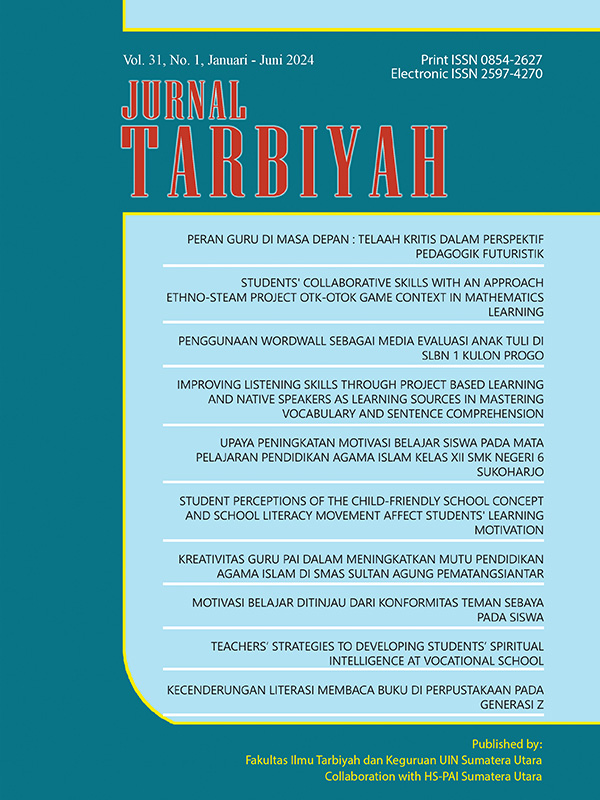
STUDENT PERCEPTIONS OF THE CHILD-FRIENDLY SCHOOL CONCEPT AND SCHOOL LITERACY MOVEMENT AFFECT STUDENTS' LEARNING MOTIVATION
DOI:
https://doi.org/10.30829/tar.v31i1.3473Abstract
This study aims to determine the influence of students' perceptions of the concept of child-friendly schools and the school literacy movement on the learning motivation of high-grade students in elementary schools. The research method used is a survey with data collection using questionnaires, while data analysis uses descriptive statistics and inferential statistics with multiple linear regression analysis as a hypothesis test. Grade V students in four public elementary schools in Cimanggis sub-district, Depok City were selected as research samples through the use of simple cluster random sampling techniques. The results showed that all regression models tested partially had calculated values of thitung > ttabel and significance values (Sig.) < (α = 0.05) which means that there is a significant influence on students' perceptions of child-friendly schools on student learning motivation and students' perceptions of school literacy movements on student learning motivation, and the regression models tested simultaneously have Fhitung > Ftabel values and significance values (Sig.) < (α = 0.05) which This means that there is a significant influence on students' perceptions of child-friendly schools and the school literacy movement simultaneously on student learning motivation. Based on these results, the conclusions of this study are: first, students' perceptions of child-friendly schools have a significant effect on the learning motivation of grade V elementary school students; second, students' perceptions of the school literacy movement have a significant effect on the learning motivation of grade V elementary school students; third, students' perceptions of child-friendly schools and the school literacy movement simultaneously have a significant effect on the learning motivation of Grade V elementary school students.References
Afifah, I., & Kunaenih, K. (2023). Pengaruh Sekolah Ramah Anak Terhadap Motivasi Belajar Siswa ( Studi Analisis SMKN 40 Jakarta ). Jurnal Sains Dan Teknologi, 5(1), 445–450. https://doi.org/10.55338/saintek.v5i1.1384
Arini, W., Dibia, I. K., & Bayu, I. G. W. (2020). School Literacy Movement Enhancing Students’ Writing Skills and Creative Thinking Skills. Jurnal Ilmiah Sekolah Dasar, 4(4), 546–552. https://doi.org/10.23887/JISD.V4I4.29847
Bakar, R. (2014). The Effect of Learning Motivation on Student’s Productive Competencies in Vocational High School, West Sumatra. International Journal of Asian Social Science, 4(6), 2226–5139. http://www.aessweb.com/journals/5007
Djaali. (2020). Metode Penelitian Kuantitatif. Jakarta: Bumi Aksara.
Elshareif, E., & Mohamed, E. A. (2021). The effects of E-learning on students’ motivation to learn in higher education. Online Learning Journal, 25(3), 128–143. https://doi.org/10.24059/olj.v25i3.2336
Ginanjar, A. Y., & Widayanti, W. (2019). Penerapan Model Pembelajaran Multiliterasi Untuk Meningkatkan Kemampuan Literasi Matematis Siswa DI SD/MI. Primary : Jurnal Keilmuan Dan Kependidikan Dasar, 10(2), 117. https://doi.org/10.32678/primary.v10i02.1283
Khairunnisah, K., Mardianto, M., & Khadijah, K. (2021). The Relationship Between Teachers’ Ability in Managing Class and Students’ Motivation With Students’ Outcomes in Fiqh Class At MDTA BABUL ULUM MEDAN. JURNAL TARBIYAH, 28(1), 89. https://doi.org/10.30829/tar.v28i1.973
Kholiq, S. M. (2018). Rintisan Sekolah Ramah Anak Di Sekolah Dasar Negeri Mentel II Gunungkidul the Pionering of Friendly School in Elementary School ff Mentel 2 Gunungkidul. Jurnal Kebijakan Pendidikan, 7, 516. https://doi.org/https://doi.org/10.21831/sakp.v7i5.13150
Marmoah, S., & Poerwanti, Suharno, J. I. S. (2022). Literacy culture management of elementary school in Indonesia. Heliyon, 8(4), e09315. https://doi.org/10.1016/j.heliyon.2022.e09315
Nirmala, S. D. (2022). Problematika Rendahnya Kemampuan Literasi Siswa Di Sekolah Dasar. Primary: Jurnal Pendidikan Guru Sekolah Dasar, 11(2), 393. https://doi.org/10.33578/jpfkip.v11i2.8851
Prasetia, I., Sulasmi, E., & Susana, S. (2021). The Child-Friendly School Program for Developing a Character School in the Primary Schools of Binjai City, Indonesia. Randwick International of Social Science Journal, 2(4), 575–582. https://doi.org/10.47175/rissj.v2i4.338
Puspitarini, Y. D., & Hanif, M. (2019). Using Learning Media to Increase Learning Motivation in Elementary School. Anatolian Journal of Education, 4(2), 53–60. https://doi.org/10.29333/aje.2019.426a
Salma, A., & . M. (2019). Analisis Gerakan Literasi Sekolah Terhadap Minat Baca Siswa Siswa Sekolah Dasar. MIMBAR PGSD Undiksha, 7(2). https://doi.org/10.23887/JJPGSD.V7I2.17555
Sidik, Z., & Sobandi, A. (2018). Upaya Meningkatkan Motivasi Belajar Siswa Melalui Kemampuan Komunikasi Interpersonal Guru. Jurnal Pendidikan Manajemen Perkantoran, 3(2), 50. https://doi.org/10.17509/jpm.v3i2.11764
Sriyanti, S., & Asbari, M. (2024). Pencegahan dan Penanganan Kekerasan di Lingkungan Satuan Pendidikan. JOURNAL OF INFORMATION SYSTEMS AND MANAGEMENT, 03(01). https://doi.org/10.4444/jisma.v3i1.877
Sugiyono. (2019). Metode Penelitian Kuantitatif. Bandung: Alfabeta.
Tanveer, M. A., Farooq, M. F., Amar. Muhammad, Danial Aslam, H., & Shabbir, M. F. (2012). Influence of Teacher on Student’ Learning Motivation in Management Sciences Studies. American Journal of Scientific Research. http://www.eurojournals.com/ajsr.htm
Wahyuni, P. D., Djatmika, E. T., & As’ari, A. R. (2018). Pengaruh Full Day School dan Gerakan Literasi Sekolah terhadap Hasil Belajar dengan Mediasi Motivasi Belajar. Jurnal Pendidikan: Teori, Penelitian, Dan Pengembangan. https://doi.org/https://doi.org/10.17977/jptpp.v3i5.11096
Wardani, A. D., Gunawan, I., Kusumaningrum, D. E., Benty, D. D. N., Sumarsono, R. B., Nurabadi, A., & Handayani, L. (2020). Student Learning Motivation: A Conceptual Paper. Proceedings of the 2nd Early Childhood and Primary Childhood Education (ECPE 2020). https://doi.org/10.2991/assehr.k.201112.049
Widiastuti, S. K., & Iriani, A. (2023). The School Literacy Movement Program During a Pandemic: Countenance Stake Model. International Journal of Elementary Education, 7(2), 230–242. https://doi.org/10.23887/ijee.v7i2.53749
Wiguna, A. C., Oktari, D., Tobing, J. A. D. E., & Fajar, R. P. A. L. (2022). Problematika Literasi Membaca Pada Generasi Penerus Bangsa Dalam Menghadapi Abad 21. Naturalistic: Jurnal Kajian Penelitian Dan Pendidikan Dan Pembelajaran, 7(1), 1478–1489. https://doi.org/https://doi.org/10.35568/naturalistic.v7i1.2172
Yosada, K. R., & Kurniati, A. (2019). Menciptakan Sekolah Ramah Anak. JURNAL PENDIDIKAN DASAR PERKHASA: Jurnal Penelitian Pendidikan Dasar, 5(2), 145–154. https://doi.org/10.31932/jpdp.v5i2.480
Zulfikar, Z., Asiz, S. A., & Haslindah, H. (2023). The Influence of the Literacy Movement on the Learning Motivation and Activeness of Elementary School Students. Pedagogik Journal of Islamic Elementary School, 6(1), 85–96. https://doi.org/10.24256/pijies.v6i1.3805
Downloads
Published
Issue
Section
License
Authors who publish with this journal agree to the following terms:
Authors are able to enter into separate, additional contractual arrangements for the non-exclusive distribution of the journal's published version of the work (e.g., post it to an institutional repository or publish it in a book), with an acknowledgement of its initial publication in this journal.
Authors are permitted and encouraged to post their work online (e.g., in institutional repositories or on their website) prior to and during the submission process, as it can lead to productive exchanges, as well as earlier and greater citation of published work (See The Effect of Open Access).
Jurnal Tarbiyah provides immediate open access to its content on the principle that making research freely available to the public supports a greater global exchange of knowledge. Jurnal Tarbiyah Open Access articles are distributed under this CC BY SA.