IMPLEMENTATION OF MADRASAH HEAD SUPERVISION IN TSANAWIYAH MADRASAH (MTS) STORED AT THE MINISTRY OF RELIGION IN TANJUNGBALAI CITY
DOI:
https://doi.org/10.30829/tar.v30i2.3574Abstract
This research aims to reveal the implementation of Supervision of Madrasah Heads in Assisted Madrasah Tsanawiyah (MTs) in the Ministry of Religion of Tanjungbalai City, how academic supervision techniques are carried out by Madrasah Heads as well as supporting and inhibiting factors in the implementation of academic supervision of Madrasah Heads in Assisted Madrasah Tsanawiyah (MTs). At the Ministry of Religion of Tanjungbalai City. The method used is a qualitative type, with a phenomenological approach, research data collection was obtained using triangulation techniques with data collection techniques from documents, interviews and observations. The results of this research reveal three findings that the implementation of academic supervision carried out by the Head of the Madrasah at the Madrasah Tsanawiyah (MTs) under the guidance of the Ministry of Religion of Tanjungbalai City is correct and follows existing procedures but the implementation is not optimal because there are still obstacles in its implementation such as facilities and infrastructure and other.References
Aedi Nur. (2014). Pengawasan Pendidikan: Tinjauan Teori dan Praktik. Jakarta: Rajawali Pers.
Daryanto. (2006). Administrasi Pendidikan. Jakarta: Rineka Cipta.
Fathurrahman, Muhammad dan Ruhyanani Hindama. (2015). Sukses Menjadi Pengawas Sekolah Ideal. Yogyakarta: Ar-Ruzz Media.
Griffin. (2006). Sumber Daya Manusia. Jakarta: Bumi Aksara.
Handoko, T. Hani. (2009). Manajemen, Edisi 2. Yogyakarta: BPFE, cet. XX.
Helmawati. (2014). Meningkatkan Kinerja Kepala Sekolah/Madrasah Melalui Managerial Skills. Jakarta: PT Rineka Cipta.
Herabudin. (2009). Administrasi dan Supervisi Pendidikan. Bandung: Pustaka Setia.
Kosasi, Achmad. (2009). Jurnal tentang Implementasi Manajemen Berbasis Sekolah (MBS)di MTsN Bantul. Kota Yogyakarta.
Mulyasa E. (2005). Menjadi Kepala Sekolah Profesional. Bandung: PT Remaja Rosdakarya.
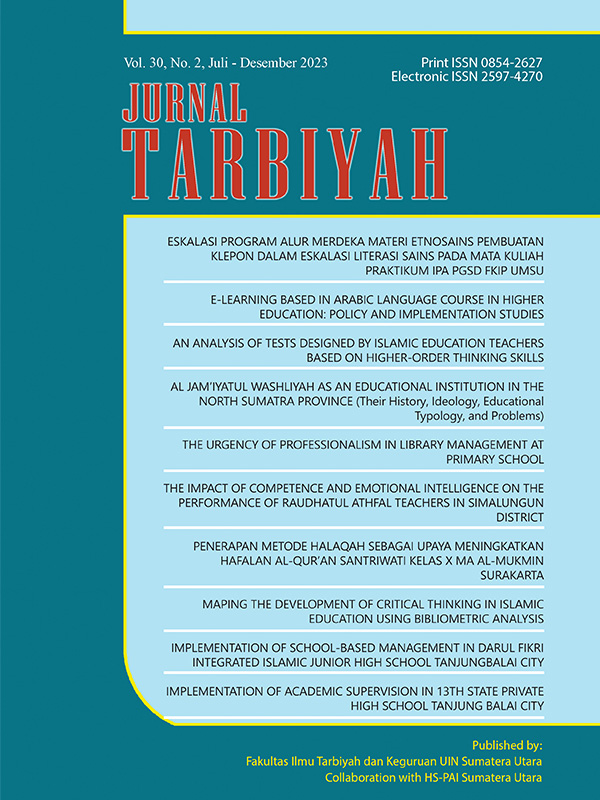
Downloads
Published
Issue
Section
License
Authors who publish with this journal agree to the following terms:
Authors are able to enter into separate, additional contractual arrangements for the non-exclusive distribution of the journal's published version of the work (e.g., post it to an institutional repository or publish it in a book), with an acknowledgement of its initial publication in this journal.
Authors are permitted and encouraged to post their work online (e.g., in institutional repositories or on their website) prior to and during the submission process, as it can lead to productive exchanges, as well as earlier and greater citation of published work (See The Effect of Open Access).
Jurnal Tarbiyah provides immediate open access to its content on the principle that making research freely available to the public supports a greater global exchange of knowledge. Jurnal Tarbiyah Open Access articles are distributed under this CC BY SA.