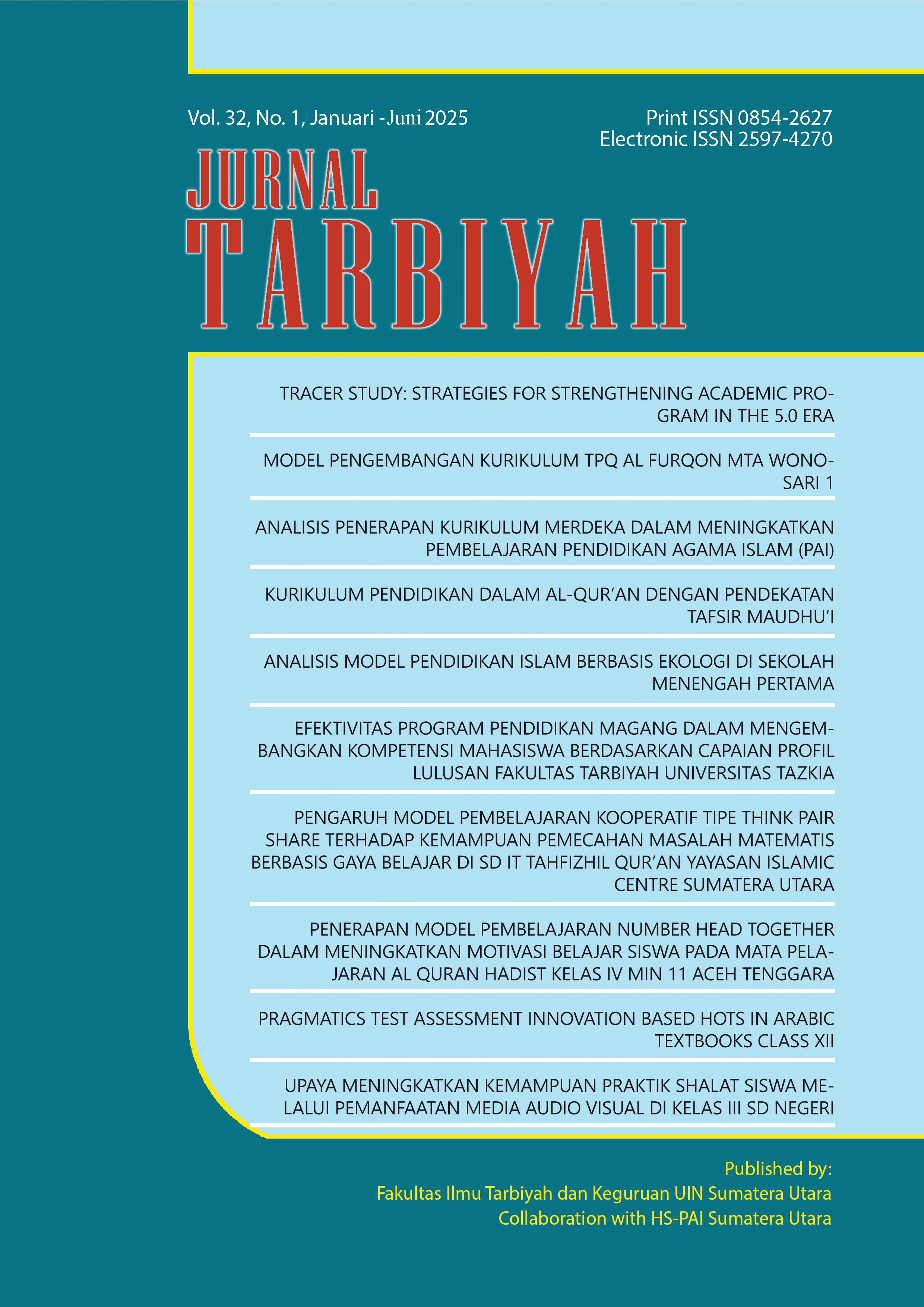
ANALISIS MODEL PENDIDIKAN ISLAM BERBASIS EKOLOGI DI SEKOLAH MENENGAH PERTAMA
DOI:
https://doi.org/10.30829/tar.v31i1.4451Abstract
This study aims to analyze the implementation of Ecology-Based Islamic Education and its leading indicators at SMP At-Tin UMP Margasari, emphasizing the Islamic concept of human responsibility as a caliph on earth. Using a qualitative case study approach, in-depth interviews were conducted with the principal and students to explore integrating Islamic values into ecological education. Data were analyzed using NVivo software to facilitate coding and grouping of themes, including "Integration of Islamic and Ecological Education," "Ecological Activities in the Curriculum," and "Impact on Student Behavior." The findings indicate that ecological practices implemented in the curriculum increase environmental awareness as part of religious obligations, which impacts students' daily behaviors such as waste management and energy saving. Practical activities such as Green Schools and agricultural projects also strengthen students' understanding of sustainability principles. This study provides practical insights for schools seeking to integrate ecological awareness with religious values, supporting sustainable environmental practices as part of Islamic education. Further studies are recommended to expand the sample size and use longitudinal methods to assess the long-term impact on student behavior.References
Alimron, A., Syarnubi, S., & Maryamah, M. (2023). Character Education Model in Islamic Higher Education. In AL-ISHLAH: Jurnal Pendidikan (Vol. 15, Issue 3, pp. 3334–3345). STAI Hubbulwathan Duri. https://doi.org/10.35445/alishlah.v15i3.1452
Almaiah, M. A. (2020). Exploring the critical challenges and factors influencing the E-learning system usage during COVID-19 pandemic. Education and Information Technologies, 25(6), 5261–5280. https://doi.org/10.1007/s10639-020-10219-y
Arifin, R. M. (2020). How to Create a System Ecological Theory of the Environment in Revolution 4.0 Era? In Journal of Physics: Conference Series (Vol. 1529, Issue 5). https://doi.org/10.1088/1742-6596/1529/5/052074
Budiman. (2016). Korelasi Spiritualitas Kependidikan dengan Sikap Pelestarian Lingkungan Hidup Mahasiswa Tarbiyah IAIN Zawiyah Cotkala Langsa. Jurnal Tarbiyah, 23(1), 124–149.
Diallo, I. (2012). “Every little tree has its own bit of shade”: Qur’an-based literacy of the peul fuuta community. International Journal of Pedagogies and Learning, 7(3), 227–238. https://doi.org/10.5172/ijpl.2012.7.3.227
Diffenbaugh, N. S. (2020). The COVID-19 lockdowns: a window into the Earth System. In Nature Reviews Earth and Environment (Vol. 1, Issue 9, pp. 470–481). https://doi.org/10.1038/s43017-020-0079-1
Fahrurrazi. (2019). To be ecological is to become pluralist: Inclusive religious education at the eco-pesantren Ath-Thaariq, West Java. Studies in Interreligious Dialogue, 9(1), 23–42. https://doi.org/10.2143/SID.29.1.3286453
Hannigan, G. D. (2013). Microbial ecology of the skin in the era of metagenomics and molecular microbiology. Cold Spring Harbor Perspectives in Medicine, 3(12). https://doi.org/10.1101/cshperspect.a015362
Hayward, B. (2013). Rethinking resilience: Reflections on the earthquakes in Christchurch, New Zealand, 2010 and 2011. Ecology and Society, 18(4). https://doi.org/10.5751/ES-05947-180437
Karim, S. S. A. (2021). Omicron SARS-CoV-2 variant: a new chapter in the COVID-19 pandemic. In The Lancet (Vol. 398, Issue 10317, pp. 2126–2128). https://doi.org/10.1016/S0140-6736(21)02758-6
Lobe, B. (2020). Qualitative Data Collection in an Era of Social Distancing. International Journal of Qualitative Methods, 19. https://doi.org/10.1177/1609406920937875
Miyawaki, S. (2016). Tumour resistance in induced pluripotent stem cells derived from naked mole-rats. Nature Communications, 7. https://doi.org/10.1038/ncomms11471
Ogunbado, A. F. (2016). The significance of Islamic spiritual ethics in human personality development. International Review of Management and Marketing, 6(8), 119–124.
Pohl, F. (2006). Islamic education and civil society: Reflections on the pesantren tradition in contemporary Indonesia. Comparative Education Review, 50(3), 389–409.
Pranata, S. P., & Husain, H. (2022). Pembuatan Mural Islami Sebagai Sarana Edukasi Pada Pesantren Taruna Alqolam Creation Of Islamic Murals As A Means of Education The Alqolam Taruna Islamic Boarding School Universitas Mahkota Tricom Unggul , Medan , Indonesia Institut Turatea Indonesia , Ma. 2(1), 96–104.
Quéré, C. Le. (2021). Fossil CO2 emissions in the post-COVID-19 era. Nature Climate Change, 11(3), 197–199. https://doi.org/10.1038/s41558-021-01001-0
Rahardjanto, A. (2018). Study of Learning Strategy Integration of Science and Religion on the Development of Student Character. Atlantis, 231, 645–648. https://doi.org/10.2991/amca-18.2018.178
Ruan, W. (2021). Circadian rhythm as a therapeutic target. In Nature Reviews Drug Discovery (Vol. 20, Issue 4, pp. 287–307). https://doi.org/10.1038/s41573-020-00109-w
Rupert, D. J. (2014). Perceived healthcare provider reactions to patient and caregiver use of online health communities. Patient Education and Counseling, 96(3), 320–326. https://doi.org/10.1016/j.pec.2014.05.015
Schmitz, B. (2008). Asteroid breakup linked to the Great Ordovician Biodiversification Event. Nature Geoscience, 1(1), 49–53. https://doi.org/10.1038/ngeo.2007.37
Susilo, A., Rumende, C. M., Pitoyo, C. W., Santoso, W. D., Yulianti, M., Herikurniawan, H., Sinto, R., Singh, G., Nainggolan, L., & Nelwan, E. J. (2020). Coronavirus disease 2019: Tinjauan literatur terkini. Jurnal Penyakit Dalam Indonesia, 7(1).
Susilo, J., Tamam, A. M., & Alim, A. (2023). Modul Pembelajaran Akidah Di Kelas X Sekolah Menengah Atas. Islamic Management: Jurnal Manajemen Pendidikan Islam, 6(02).
Usman, I. M. (2013). Pesantren sebagai lembaga pendidikan islam. Jurnal Al Hikmah, 14(1), 101–119.
Yusmaliana, D. (2023). Ecological Education in Islamic Religious Learning Based on Creative Imagination. In World Sustainability Series (pp. 53–68). https://doi.org/10.1007/978-981-99-7572-3_4
Downloads
Published
Issue
Section
License
Authors who publish with this journal agree to the following terms:
Authors are able to enter into separate, additional contractual arrangements for the non-exclusive distribution of the journal's published version of the work (e.g., post it to an institutional repository or publish it in a book), with an acknowledgement of its initial publication in this journal.
Authors are permitted and encouraged to post their work online (e.g., in institutional repositories or on their website) prior to and during the submission process, as it can lead to productive exchanges, as well as earlier and greater citation of published work (See The Effect of Open Access).
Jurnal Tarbiyah provides immediate open access to its content on the principle that making research freely available to the public supports a greater global exchange of knowledge. Jurnal Tarbiyah Open Access articles are distributed under this CC BY SA.