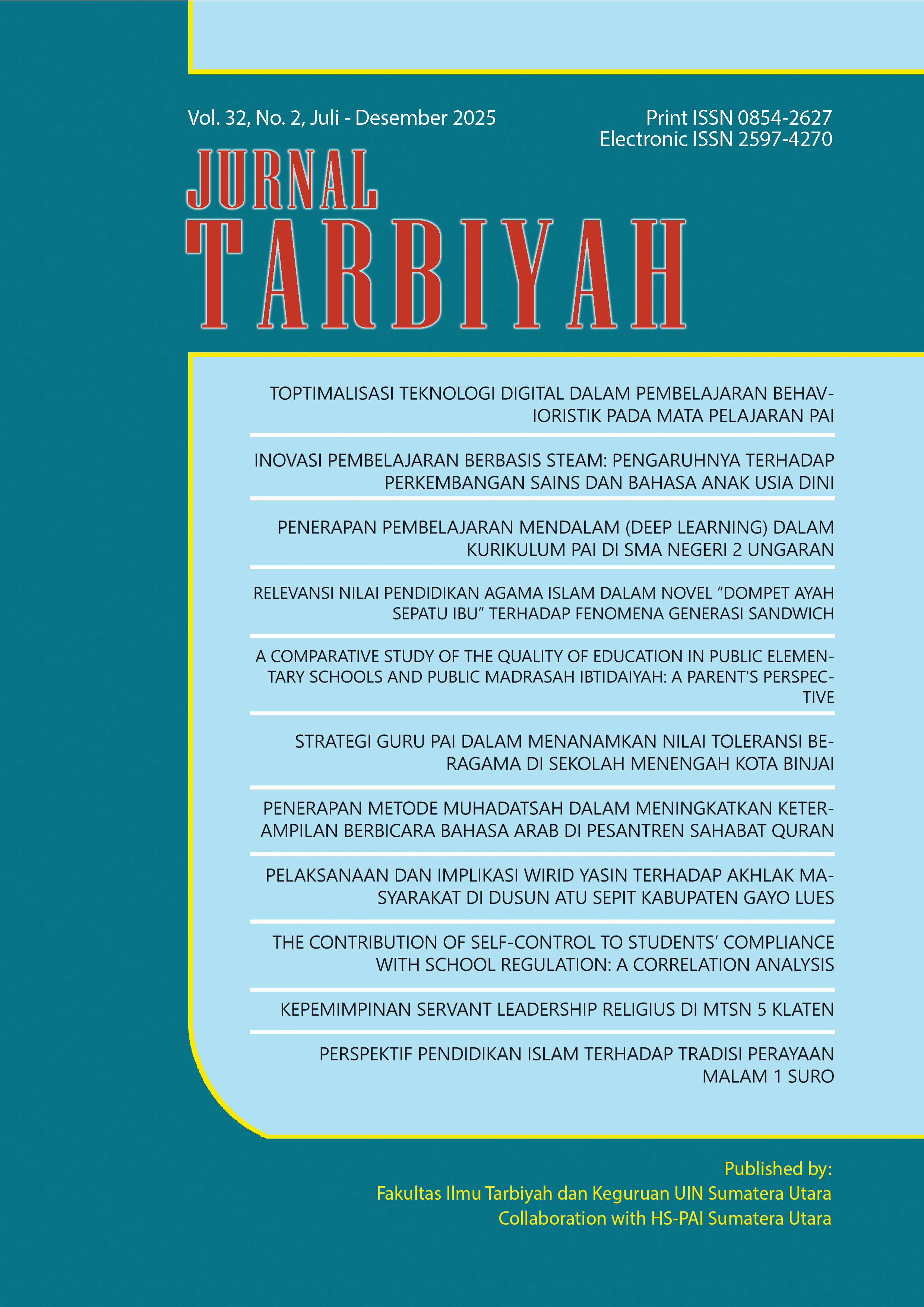
THE CONTRIBUTION OF SELF-CONTROL TO STUDENTS’ COMPLIANCE WITH SCHOOL REGULATION: A CORRELATION ANALYSIS
DOI:
https://doi.org/10.30829/tar.v32i2.4775Abstract
Student discipline is a key factor in creating an effective learning climate in schools; however, violations of school regulations are still frequently observed, often due to weak self-control among adolescents. This study aims to examine the relationship between self-control and adherence to school rules among twelfth-grade students. A quantitative approach with a correlational design was employed. The sample comprised 102 students randomly selected from a population of 239. Data were collected using a closed-ended, Likert-scale questionnaire that had been validated and proven reliable. Data analysis was conducted using Pearson product-moment correlation with the assistance of SPSS software. The results revealed a significant positive relationship between self-control and student discipline in adhering to school rules (r = 0.557, p < 0.05), with self-control contributing 31.10% to the variance in student discipline. These findings underscore the importance of strengthening self-control development programs through counseling services and habituation of discipline in schools as strategic efforts to improve students’ compliance with school regulations.References
Adlya, S. I., Yusuf, A. M., & Effendi, M. (2020). The contribution of self control to students’ discipline. Journal of Counseling and Educational Technology, 3(1), 1. https://doi.org/10.32698/0791
Alam, M. M., & Fitriatin, N. (2024). Factors Affecting Student Discipline: A Case Study in Junior High Schools, Indonesia. Journal of Asian Islamic Educational Management (JAIEM), 2(1), 11–18. https://doi.org/10.53889/jaiem.v2i1.543
Amelia, N., Amelia, N., & Nurhaliza. (2023). Casual Factors and Sanctions For Disciplinary Violation Of School Rules. International Journal of Education and Teaching Zone, 2(1), 83–94. https://doi.org/10.57092/ijetz.v2i1.87
Arikunto, S. (2021). Dasar-Dasar Evaluasi Pendidikan Edisi 3 (3rd ed.). Jakarta: Bumi Aksara.
Duckworth, A. L., Taxer, J. L., Eskreis-Winkler, L., Galla, B. M., & Gross, J. J. (2019). Self-Control and Academic Achievement. Annual Review of Psychology, 70(1), 373–399. https://doi.org/10.1146/annurev-psych-010418-103230
Gillebaart, M. (2018). The ‘Operational’ Definition of Self-Control. Frontiers in Psychology, 9(JUL), 1–5. https://doi.org/10.3389/fpsyg.2018.01231
Gunawan, R., & Wangid, M. N. (2025). Enhancing Learning Discipline Through Self-Management and Modelling Techniques: A Study of Students at Cipasung Tasikmalaya Islamic Middle School. AL-ISHLAH: Jurnal Pendidikan, 17(1), 1766–1772. https://doi.org/10.35445/alishlah.v17i1.5907
Hidayah, R. (2021). Students’ self-adjustment, self-control, and morality. Journal of Social Studies Education Research, 12(1), 174–193. https://jsser.org/index.php/jsser/article/view/3075/495
Holmes, C., Brieant, A., Kahn, R., Deater-Deckard, K., & Kim-Spoon, J. (2019). Structural Home Environment Effects on Developmental Trajectories of Self-Control and Adolescent Risk Taking. Journal of Youth and Adolescence, 48(1), 43–55. https://doi.org/10.1007/s10964-018-0921-7
Laoli, B., Laoli, E. S., & Lase, A. (2023). The Role of Teachers in Dealing with Student Behavior Regarding School Rules Violations (Bezisokhi laoli) The Role of Teachers in Dealing with Student Behavior Regarding School Rules Violations. JP(Jurnal Pendidikan): Teori Dan Praktik, 8(2), 172–183. https://doi.org/https://doi.org/10.26740/jp.v8n2.p172-183
Li, J.-B., Bi, S.-S., Willems, Y. E., & Finkenauer, C. (2021). The Association Between School Discipline and Self-Control From Preschoolers to High School Students: A Three-Level Meta-Analysis. Review of Educational Research, 91(1), 73–111. https://doi.org/10.3102/0034654320979160
Likert, R. (1932). A Technique for The Measurement of Attitudes. In Archives of Psychology. New York University. https://legacy.voteview.com/pdf/Likert_1932.pdf
Maingi, D., Maithya, R., Mulwa, D., & Migosi, J. (2017). Influence of School Rules ’ Formulation on Students ’ Discipline in Public Secondary Schools in Makueni County. International Journal of Humanities and Social Science Invention, 6(1), 1–6. http://ir.mksu.ac.ke/handle/123456780/2159
Oktaviani, D., Kurnia, H., Paryanto, P., Kusumawati, I., & Bowo, A. N. A. (2024). The Relationship between School Rules Implementation and Student Discipline Level. Sustainable Jurnal Kajian Mutu Pendidikan, 7(1), 28–36. https://doi.org/10.32923/kjmp.v7i1.4301
Parker, D. K. (2006). Menumbuhkan kemandirian dan harga diri anak. Jakarta: PT Prestasi Pustakaraya.
Sari, M., & Netrawati. (2025). Group Counseling Innovation: Self-Management Techniques for Enhancing Discipline Among Vocational High School Students. Journal of Educational, Health and Community Psychology, 14(1), 98–116. https://doi.org/10.12928/jehcp.vi.30279
Senjaya, P., Kotamena, F., Ong, F., Andika, C. B., Purwanto, A., & Pramono, R. (2020). School environmental influences, student discipline and learning motivation toward increasing senior high students achievement. International Journal of Advanced Science and Technology, 29(5), 4572–4586. https://papers.ssrn.com/sol3/papers.cfm?abstract_id=3985889
Smith, T., Panfil, K., Bailey, C., & Kirkpatrick, K. (2019). Cognitive and behavioral training interventions to promote self-control. Journal of Experimental Psychology: Animal Learning and Cognition, 45(3), 259–279. https://doi.org/10.1037/xan0000208
Sugiyono, S. (2018). Metode Penelitian Kuatitatif, Kualitatif dan R & D Edisi 15. Bandung: Alfabeta.
Syarif, A., Baderiah, B., & Taqwa, T. (2024). Enhancing Students’ Character Development through a Point-Based Violation System. International Journal of Asian Education, 5(4), 363–373. https://doi.org/10.46966/ijae.v5i4.464
Thalib, S. B. (2021). Psikologi Pendidikan Berbasis Analisis Empiris Aplikatif (Edisi Revisi 2021). Prenada Media Group. https://anyflip.com/fgypi/xggk/basic
Downloads
Published
Issue
Section
License
Authors who publish with this journal agree to the following terms:
Authors are able to enter into separate, additional contractual arrangements for the non-exclusive distribution of the journal's published version of the work (e.g., post it to an institutional repository or publish it in a book), with an acknowledgement of its initial publication in this journal.
Authors are permitted and encouraged to post their work online (e.g., in institutional repositories or on their website) prior to and during the submission process, as it can lead to productive exchanges, as well as earlier and greater citation of published work (See The Effect of Open Access).
Jurnal Tarbiyah provides immediate open access to its content on the principle that making research freely available to the public supports a greater global exchange of knowledge. Jurnal Tarbiyah Open Access articles are distributed under this CC BY SA.