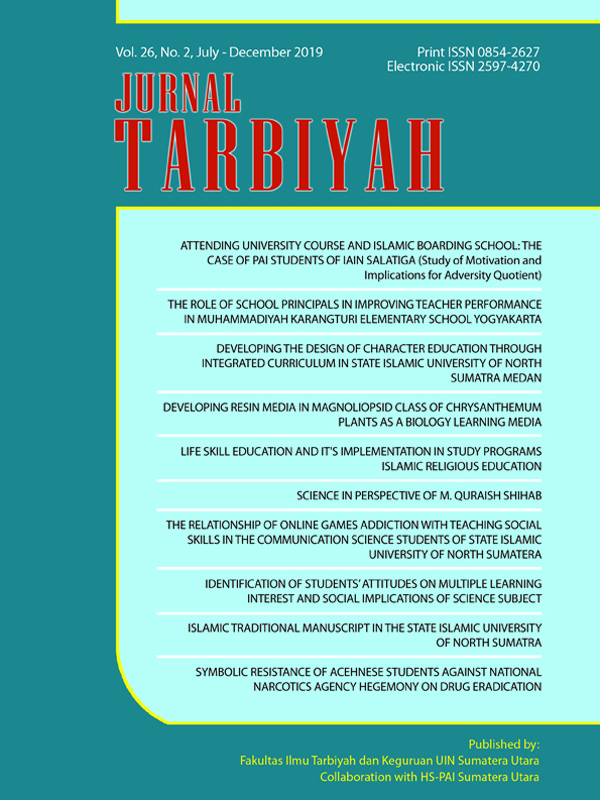
SYMBOLIC RESISTANCE OF ACEHNESE STUDENTS AGAINST NATIONAL NARCOTICS AGENCY HEGEMONY ON DRUG ERADICATION
DOI:
https://doi.org/10.30829/tar.v26i2.558Abstract
This study will describe the form of symbolic resistance of Acehnese students to drug eradication and photograph the forms of hegemony represented by the NNA Aceh in eradicating drugs for students in Aceh using the symbolic resistance theory of James C. Scott and Gramsci's hegemony. This research explored information through informants by conducting in-dept interviews, participant observation and documentation. This study found that the presence of students carrying symbolic resistance to drug eradication carried out by the National Narcotics Agency in the form of feeling uncomfortable, rejection body language, pouting officers and looking for excuses when counseling was conducted. This symbolic resistance emerged as a reaction to hegemony in various forms, namely dissemination, anti-drug volunteers, monday national flag ceremony, urine tests, seminar, DAPEICP curriculum and MoU.References
National Narcotics Agent (NNA). (2018). Badan Narkotika Nasional Republik Indonesia. Online. (http://www/bnn.go.id/). Accessed on 2019, Dec 3rd.
Harahap, I.M, Perngmark, P. & Chanchong, W. (2012). Substance Use among Muslim Students in Aceh, Indonesia. Nurse Media Journal of Nursing. Vol. 2(2): 421-436.
Helviza, I., Mukmin, Z. & Amirullah. (2016). Kendala-Kendala Badan Narkotika Nasional (BNN) dalam Penanggulangan Penyalahgunaan Narkotika di Kota Banda Aceh. Jurnal Ilmiah Mahasiswa Pendidikan Kewarganegaraan Unsyiah. Vol. 1(1): 128-146.
Herindrasti, V.L.S. (2018). Drug-free ASEAN 2025: Tantangan Indonesia dalam Penanggulangan Penyalahgunaan Narkoba. Jurnal Hubungan Internasional. Vol.7(1): 19-23.
Miles, M.B.A & Huberman, M. (1992). Analisis Data Kualitatif: Buku Sumber Tentang Metode-Metode Baru. (Rohidi, T.R., Translation). Jakarta: UI Press.
Mukhlis, M. (2013). Pola Komunikasi Islam Penyuluh dalam Pencegahan dan Pemberantasan Bahaya Penyalahgunaan Narkoba di Kalangan Remaja Kota Langsa. (Tesis: Program Pascasarjana IAIN Sumut)
Nazir, M. (2004). Metode Penelitian. Jakarta: Ghalia Indonesia.
Nurlaelah, Harakan, A. & Mone, A. (2019). Strategi Badan Narkotika Nasional (BNN) dalam Mencegah Peredaran Narkotika di Kota Makassar. Journal of Goverment and Political Studies, Vol. 2(1): 24-31.
Patria, N, & Arief, A. (2003). Antonio Gramsci: Negara dan Hegemoni. Yogyakarta: Pustaka Pelajar.
Pengungkapan Kasus Narkoba, (2017, April 1). Serambi Indonesia.
Prohaba. (2017, Oktober 2). Polisi Cokok Komplotan Pengedar Sabu di Kalangan Pelajar. Diakses di http://prohaba.co/m/index.php/2016/07/19/polisi-cokok-kom-plotan-pengedar-sabu-di-kalangan-pelajar.
Ruslan, R. (2008). Metode Penelitian Public Relations dan Komunikasi (Edisi 4). Jakarta: Raja Grafindo Persada.
Scott, J. (2000). Senjatanya Orang-orang Kalah. Jakarta: Yayasan Obor Indonesia.
Simon,R. (2014). Gagasan-Gagasan Politik Gramsci. (Kamdani dan Imam Baehagi, Translation). Yogyakarta: Pustaka Pelajar.
Sindonews. (2017, Oktober 22). Kecanduan Narkoba Sejak SMP Pelajar SMU Ini Jadi Bandar. Diakses dari https://daerah.sindonews.com/read/11243368/174/ kecanduan-narkoba-sejak-smp-pelajar-smu-ini-jadi-bandar-1468848987.
Sutopo. (2006). Metodologi Penelitian Kualitatif. Surakarta: UNS Press.
United Nations Office on Drugs and Crime (UNODC). (2019). World Drug Report 2019. Vienna: UNODC Research.
Downloads
Published
Issue
Section
License
Authors who publish with this journal agree to the following terms:
Authors are able to enter into separate, additional contractual arrangements for the non-exclusive distribution of the journal's published version of the work (e.g., post it to an institutional repository or publish it in a book), with an acknowledgement of its initial publication in this journal.
Authors are permitted and encouraged to post their work online (e.g., in institutional repositories or on their website) prior to and during the submission process, as it can lead to productive exchanges, as well as earlier and greater citation of published work (See The Effect of Open Access).
Jurnal Tarbiyah provides immediate open access to its content on the principle that making research freely available to the public supports a greater global exchange of knowledge. Jurnal Tarbiyah Open Access articles are distributed under this CC BY SA.