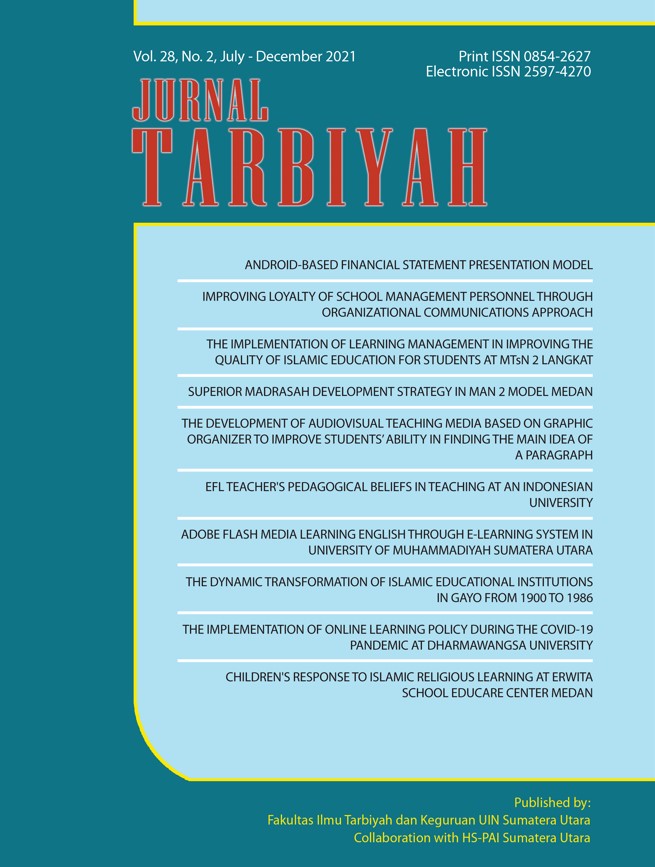
THE DEVELOPMENT OF AUDIOVISUAL TEACHING MEDIA BASED ON GRAPHIC ORGANIZER TO IMPROVE STUDENTS’ ABILITY IN FINDING THE MAIN IDEA OF A PARAGRAPH
DOI:
https://doi.org/10.30829/tar.v28i2.1118Abstract
This study aims to determine the validity, practicality, and effectiveness of the development of audio-visual teaching media based on Graphic Organizer to improve students’ ability to find the main idea of a paragraph at the fifth grade of MIN 2 in Labuhanbatu Selatan. This study follows the Research and Development (R & D) developed by Borg and Gall and has been modified by Sugiyono. This includes nine steps, namely; Potential and Problems, Gathering Information, Product Design, Design Validation, Design Revision, Product Trial, Revision Product, Trial of Use, and Revision of Final Products. The data were collected from interviews, observation, and questionnaires. There were three instruments used, namely preliminary instruments, product development instruments, and product testing instruments. The data were analyzed using descriptive qualitative and quantitative analysis to describe the results of product development. The findings of this study indicate that 1) the validity of assessment made by the material experts of the product media was found to be 80%. The media expert’s assessment of product media obtained a percentage of 86.6%; 2) In terms of the practicality of the product, the percentage of responses given by small-scale students shows 97.6% and the percentage of responses given by large-scale students is 98.4%. Meanwhile, the results of the questionnaires filled by the teacher is 100%, which is adjusted to the practicality criteria table; 3) the average score for the effectiveness before using the product is 76.87%. Meanwhile, the average score for the effects after using the product is 94.37References
Candler, Laura. 2012. Graphic Organizers for Reading. Teaching Resources. Inc.
Damanik, R., Sagala, R. W., & Rezeki, T. I. (2021). Keterampilan Dasar Mengajar Guru (Vol. 1). umsu press.
Erdiana, 2017. Pengaruh Keefektifan Membaca Cepat Terhadap Kemampuan Menemukan Ide Pokok Paragraf” Jurnal Diksatrasia. Vol. 1 No 2
Gurusinga Mayasari Laura, 2016. Hubungan Keterampilan Membaca Intensif Dengan Kemampuan Menemukan Ide Pokok Paragraf Siswa Kelas Viii Smp Pencawan Medan Tahun Pelajaran 2012-2013. Jurnal Edukasi Kultura. Vol 3 No 1
Hammid, dkk 2020. Media Pembelajaran. Medan: Yayasan Kita Mneulis
Hidayat dkk, 2020. Pengembangan Model Pembelajaran Atletik Nomor Lari Berbasis Permainan Pada Siswa Sekolah Dasar, Jawa Tengah: CV. Sarnu Untung
Muhammad, 2010. Tafsir Ibnu Katsir Jilid 1. Pustaka Imam Syafi’i
Mulyani, Asep, 2014. Grafic Orgaizer dalam Pembelajaran. Jurnal Scientiae
Education. Vol. 3 No 2
Prasetyo, I, 2012 . Teknik Analisis Data Dalam Research And Development. UNY: Fakultas Ilmu Pendidikan
Prihantini, Ainia. 2015. Master Bahasa Indonesia, Yogyakarta: Penerbit B firs.
Purwono, Joni, dkk, 2014. Penggunaan Media Audio-Visual Pada Mata Pelajaran Ilmu Pengetahuan Alam Di Sekolah Menengah Pertama Negeri 1 Pacitan. Jurnal Teknologi Pendidikan dan Pembelajaran. Vol. 2 No 2
Santika, dkk, 2019. Pengaruh Model Pembelajaran Cooperative Integrated Reading And Composition (Circ) Terhadap Kemampuan Menentukan Ide Pokok Paragraf Siswa Kelas V Sd Negeri 003 Pulau Kopung Kecamatan Sentajo Raya Kabupaten Kuantan Singingi. Jurnal Pajar. Vol 3 No 2
Saputro, Budiyono, 2017. Manajemen Penelitian Pengembangan ( Research & Development ), Yogyakarta: Aswaja Perssindo
Sudarmawan, dkk, 2014. The Effect Of Graphic Organizers And Text Types On The Student Reading Competency at SMAN 8 Denpasar. Jurnal Program Pascasarjana Universitas Pendidikan Ganesha. Vol. 2 No 1
Ummysalam, 2017. Buku ajar Kurikulum bahan ajar dan media pembelajaran PLS. Yogyakarta: Penerbit Deepublish
USAID. 2014. Pebelajaran Literasi Kelas Awal di LPTK. Jakarta: USAID PRIORITAS
Downloads
Published
Issue
Section
License
Authors who publish with this journal agree to the following terms:
Authors are able to enter into separate, additional contractual arrangements for the non-exclusive distribution of the journal's published version of the work (e.g., post it to an institutional repository or publish it in a book), with an acknowledgement of its initial publication in this journal.
Authors are permitted and encouraged to post their work online (e.g., in institutional repositories or on their website) prior to and during the submission process, as it can lead to productive exchanges, as well as earlier and greater citation of published work (See The Effect of Open Access).
Jurnal Tarbiyah provides immediate open access to its content on the principle that making research freely available to the public supports a greater global exchange of knowledge. Jurnal Tarbiyah Open Access articles are distributed under this CC BY SA.