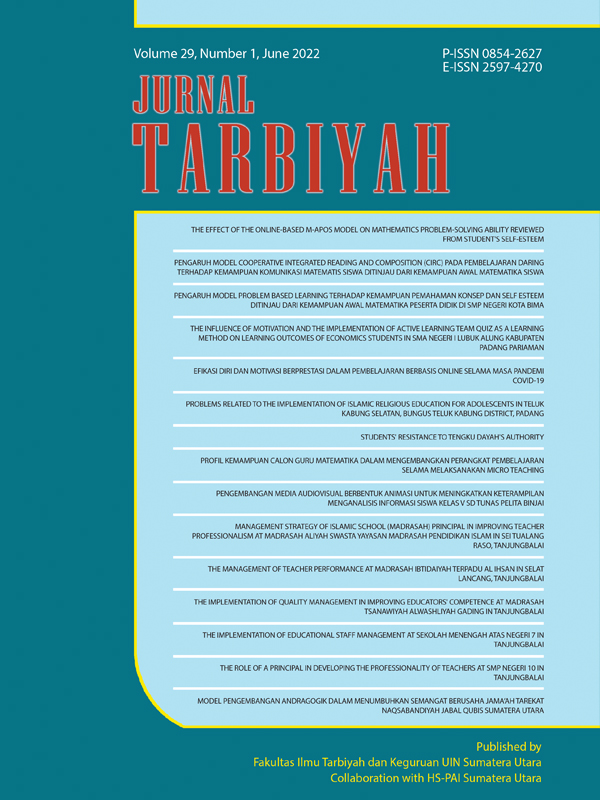
MODEL PENGEMBANGAN ANDRAGOGIK DALAM MENUMBUHKAN SEMANGAT BERUSAHA JAMA’AH TAREKAT NAQSABANDIYAH JABAL QUBIS SUMATERA UTARA
DOI:
https://doi.org/10.30829/tar.v29i1.1406Abstract
This study aims at describing a model of andragogical development implemented by the leaders of Toriqoh Naqsabandiyah Jabal Qubis to empower their followers’ spirit to work. It is conducted at the non-formal institution of Naqsabandiyah Jabal Qubis by using phenomenological qualitative approach. The data of this research consist of the results of observation, deep interview, and focus group discussion. The data sources of this study are the top leader, the big chaliph, the old chaliph, and the young caliph. The data were analysed by the Miles, Huberman, and Saldana’s (2014) technique namely data condensation, data display, dan verification. The trustworthiness of this study is established through source and methodological triangulations. The findings of this research show that a model of andragogical development in empowering the followers’ spirit is applied through 4 steps : planning, developing, evaluating, doing follow-up, as well as their impacts.References
Alam, Saidi Syekh H Amir Damsar Syarif. 2014. Pancaran Nur Muhammad, Sumatera Utara : Yayasan Jabal Qubis.
Aliwear. 2012.Alasan dan Tujuan Penggunaan Metode Pembelajaran.Diakses tanggal 17 April 2017. (https://alisadikinwear.wordpress.com/2012/07/20/metode-pembelajaran/)
Alkadhi, Selwa.( 2017). Learning Theory: Adult Education: Andragogy
California : California State University Monterey Bay
Astanti, Endah Yuli. (2016). “Pengembangan Model Andragogi untuk Meningkatkan Partisipasi Jama’ah Majelis Taklim Nurul Huda Huda Putri di Dusun Semoya TegalTirto Berbah Sleman”. Tesis. Yogyakarta: UIN Sunan Kalijaga.
Ativa, Titik.(2011). Bahan Andragogi : Beberapa Pendekatan Dalam Pendidikan Orang Dewasa.Diakses tanggal 9 April 2017 (http://92putrimedan-sitiativa.blogspot.co.id/2011/11/beberapa-pendekatan-dalam-pendidikan.html)
Bambang S. Dan Lukman (2009) Kelemahan Dan Keunggulan Teori Belajar Andragogi. Diakses tanggal 9 April 2017(http://www.oocities.org/teknologipembelajaran/andragogi.html)
Danasasmita, Wawan. Model Pembelajaran dan Pendekatannya. Diakses tanggal 17 Maret 2017 (file.upi.edu)
Danim, Sudarwan.2010. Pedagogi, Andragogi dan Heutagogi. Bandung: Alfabeta CV.
Malik, Halim. (2015).Teori Belajar Andragogi dan Penerapannya. Diakses tanggal 5 April 2017. (Teori%20Belajar%20Andragogi%20dan%20 Penerapannya.htm)
Mega. 2012. Kepememimpinan dan Semangat Kerja. Diakses tanggal 17 April 2017 (http://megasuryonop.blogspot.co.id/2012/04/kepemimpinan-dan-semangat-kerja.html)
Moleong, Lexy J.1996. Metode Penelitian Kualitatif. Bandung :Remaja Rosdakarya.
Nurchinta, Ayu dan Danang Tandyonomanu (2017). Diakses tanggal 3 Mei 2017. (http://jurnalmahasiswa.unesa.ac.id/article/16821/12/article.pdf)
Ochid, Mas. 2014. “Andragogi atau Pendidikan Orang Dewasa”. Makalah. (http://pgsdberbagi.blogspot.co.id/2014/01/makalah-andragogi-atau-pendidikan-orang.html)
Pannen, Paulina dan Ida Malati Sadjati. 2001. Pembelajaran Orang Dewasa. Jakarta: Depdiknas.
Pappas, Christoper. (2013). The Adult Learning Theory: Andragogy of Malcolm Shepherd Knowles. Diakses tanggal 5 April 2017 (https://elearningindustry.com/the-adult-learning-theory-andragogy-of-malcolm-knowles)
.
SyafiiM., Tarekat Naqsyabandiyah, diakses 17 April 2017 (http://syafii.wordpress. com/ )
Downloads
Published
Issue
Section
License
Authors who publish with this journal agree to the following terms:
Authors are able to enter into separate, additional contractual arrangements for the non-exclusive distribution of the journal's published version of the work (e.g., post it to an institutional repository or publish it in a book), with an acknowledgement of its initial publication in this journal.
Authors are permitted and encouraged to post their work online (e.g., in institutional repositories or on their website) prior to and during the submission process, as it can lead to productive exchanges, as well as earlier and greater citation of published work (See The Effect of Open Access).
Jurnal Tarbiyah provides immediate open access to its content on the principle that making research freely available to the public supports a greater global exchange of knowledge. Jurnal Tarbiyah Open Access articles are distributed under this CC BY SA.