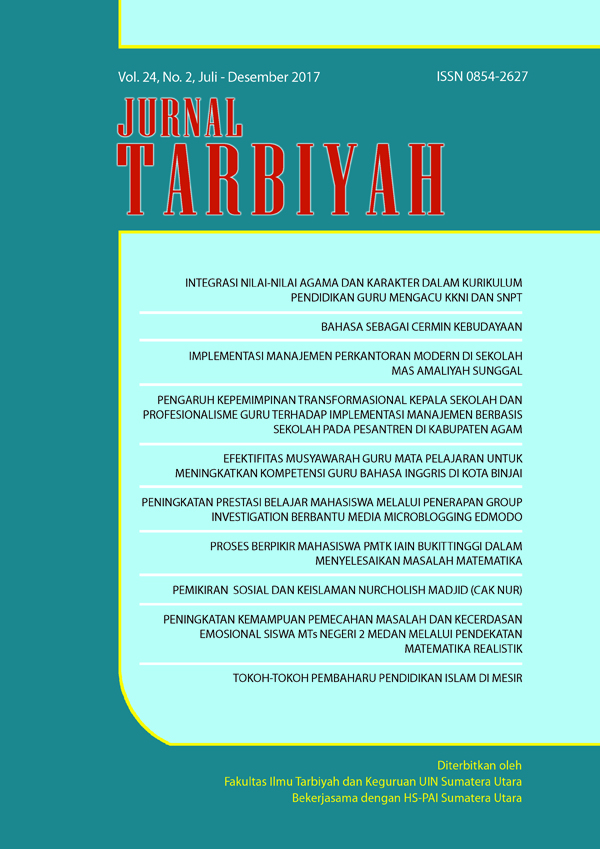
IMPLEMENTASI MANAJEMEN PERKANTORAN MODERNDI SEKOLAH
DOI:
https://doi.org/10.30829/tar.v24i2.215Abstract
Office as a place of work has an important role in achieving the goals of an organization or institution. Schools as a place of work for everyone involved in the educational process is important role to achieve the goal of educating the life of the nation should be considered management. Through a good understanding of how to manage the office a school leader can direct his school's development toward a modern school office that can help create a better nation life through well-managed education.ABSTRAK Kantor sebagai tempat bekerja memiliki peranan penting dalam mencapai tujuan suatu organisasi ataupun lembaga.Sekolah sebagai tempat bekerja bagi setiap orang yang terlibat dalam proses pendidikan yang penting peranannya terhadap tercapainya tujuan mencerdaskan kehidupan bangsa sudah seharusnya diperhatikan pengelolaannya. Melalui pemahaman yang baik terhadap cara mengelola kantor seorang pemimpin sekolah dapat mengarahkan perkembangan sekolahnya ke arah kantor sekolah yang modern yang dapat membantu terciptanya kehidupan bangsa yang lebih baik melalui pendidikan yang terkelola dengan baik.References
The Liang Gie (2000), Administrasi Perkantoran, Yogyakarta: Modern Liberty
Akmal (2005), Menata Rumah dengan Estetika.Jakarta: PT. Gramedia Pustaka Utama
Geoffrey Mills et al (1991).Manajemen Perkantoran Modern, Jakarta: Binarupa Aksara
Moekijat (2008).Administrasi Perkantoran, Bandung: Mandar Maju, 2008
Priansa dan Garnida (2013).Manajemen Perkantoran, Bandung : Alfabeta
Widodo, Suparno Eko (2011). Manajemen Mutu Pendidikan, Jakarta : Ardadizya Jaya
Komaruddin (1981). Manajemen Kantor, Teori dan Praktek, Bandung: Sinar Baru.
Downloads
Published
Issue
Section
License
Authors who publish with this journal agree to the following terms:
Authors are able to enter into separate, additional contractual arrangements for the non-exclusive distribution of the journal's published version of the work (e.g., post it to an institutional repository or publish it in a book), with an acknowledgement of its initial publication in this journal.
Authors are permitted and encouraged to post their work online (e.g., in institutional repositories or on their website) prior to and during the submission process, as it can lead to productive exchanges, as well as earlier and greater citation of published work (See The Effect of Open Access).
Jurnal Tarbiyah provides immediate open access to its content on the principle that making research freely available to the public supports a greater global exchange of knowledge. Jurnal Tarbiyah Open Access articles are distributed under this CC BY SA.