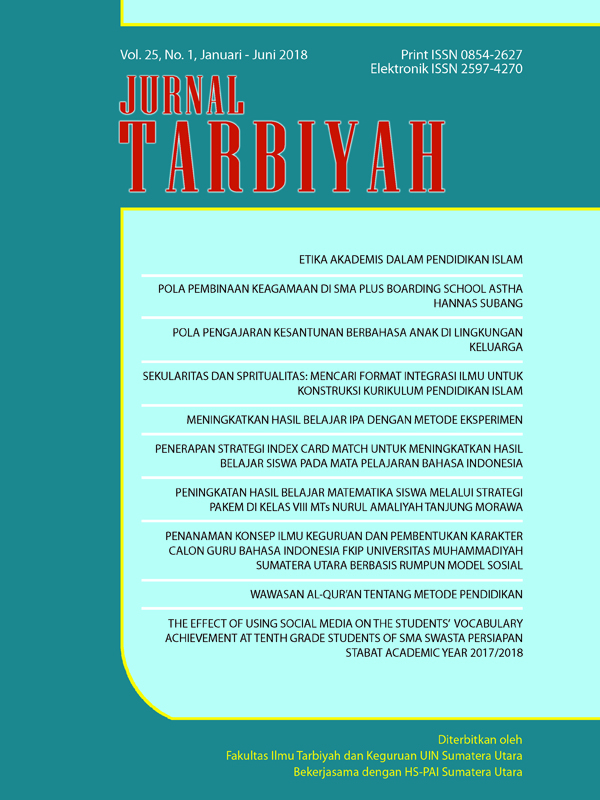
Penerapan Strategi Index Card Match Untuk Meningkatkan Hasil Belajar Siswa Pada Mata Pelajaran Bahasa Indonesia
DOI:
https://doi.org/10.30829/tar.v25i1.237Abstrak
This study aims to find out student learning outcomes by Using Index Card Match Strategy on Indonesian Subjects Event Materials Students Class V SD IT Al-Hijrah Laut Dendang. This research is a classroom action research (PTK) is a form of action research applied in the learning activities in the classroom. The population is all students in grade V SD IT Al-Hijrah Laut Dendang. Data analysis was done by variance analysis. The findings showed: 1). The result of learning of class V student of Indonesian language of event material before using Index Card Match Strategy has not proven satisfactory, with percentage of average value is 38,57%, 2) Application of Learning Strategy Index Card Match goes according to expected that is in line with research design has been designed and responded well by students of class V, 3) Implementation of Index Card Match Strategy is very appropriate to use because the results obtained increased by 63.57% in cycle I, then in cycle II the implementation of Index Card Match Strategy also increased with the value on average 77.85%.Referensi
Ahmad Susanto, Teori belajar dan pembelajaran disekolah dasar, (Jakarta : kencana, 2014) h.1
Ahmad Susanto, Teori Belajar Dan Pembelajaran Di Sekolah Dasar, (Jakarta: Kencana
Prenadamedia Group, 2014), h.5-6.
Ahmad Susanto,)2013(, Teori Belajar dan Pembelajaran di Sekolah Dasar, Jakarta: Kencana, hal. 1
Ahmad Susanto, Teori Belajar Dan Pembelajaran Di Sekolah Dasar, ( Jakarta: Kencana
Prenadamedia Group, 2014), h.12-14.
Ahmad Susanto, Teori belajar dan pembelajaran disekolah dasar, (Jakarta : kencana, 2014) h.241
-242
Djunaidy Ghony, Penelitian Tindakan Kelas, (UIN-Malang Press, 2008), h.8 Agus Suprijono,
Cooperative, hal. 11-13.
Ali Hamzah dan Muhlisrarini, Perencanaan, hal. 140.
Agus Suprijono, (2009), Cooperative Learning, Yogyakarta: Pustaka Pelajar, hal. 5-6.
Ali Hamzah dan Muhlisrarini, (2014), Perencanaan dan Strategi Pembelajaran Matematika, Jakarta:
Rajagrafindo Persada, hal. 140.
Agus Suprijono, Cooperative Learnig, (yogyakarta: PUSTAKA PELAJAR, 2010), h.120-121
Arikunto dkk.2006. penelitian tindakan kelas (Jakarta: Bumi Aksara),h.74
Haidir dan Salim, Strategi, hal. 102.
Hasbullah, Dasar-dasar Ilmu Pendidikan, (Jakarta: PT RAJAGRAFINDO PERSADA,1999), h.6
Istarani, 58 model pembelajaran inovatif, (Medan: Media Persada, 2012), h.225
Ngalimun dkk, (2016), Strategi dan Model Pembelajaran, Yogyakarta: Aswaja Pressindo, hal. 4.
Ngalimun, Strategi, hal. 4.
Nurmawati, (2014), Evaluasi Pendidikan Islam, Bandung: Cita Pustaka Media, hal. 53-60.
Roestiyah, Strategi Belajar Mengajar, (Jakarta : PT RINEKA CIPTA ,2012), h.1
Syaiful Bahri Djamarah, Psikologi Belajar, (Jakarta: Rineka Cipta, 2011), h.14-15.
Syaiful Bahri Djamarah, Psikologi Belajar, (Jakarta: Rineka Cipta, 2011), h.12-13.
Supriyadi, (2015), Strategi Belajar & Mengajar, Yogyakarta: Cakrawala Ilmu. Hal. 59.
Saiful bahri djamara, dan aswan zain, strategi belajar mengajar, (jakarta: PT Rineka Cipta, 2013),
h.5-6.
Salim, Isran Rasyid, dan Haidar, Penelitian Tindakan Kelas, (Medan: PERDANA PUBLISHING,
, h.19.
Suharsimi Arikunto,et.al., penelitian tindakan kelas (Jakarta:PT Bumi Aksara,2010), h.2-3
Unduhan
Diterbitkan
Terbitan
Bagian
Lisensi
Authors who publish with this journal agree to the following terms:
Authors are able to enter into separate, additional contractual arrangements for the non-exclusive distribution of the journal's published version of the work (e.g., post it to an institutional repository or publish it in a book), with an acknowledgement of its initial publication in this journal.
Authors are permitted and encouraged to post their work online (e.g., in institutional repositories or on their website) prior to and during the submission process, as it can lead to productive exchanges, as well as earlier and greater citation of published work (See The Effect of Open Access).
Jurnal Tarbiyah provides immediate open access to its content on the principle that making research freely available to the public supports a greater global exchange of knowledge. Jurnal Tarbiyah Open Access articles are distributed under this CC BY SA.