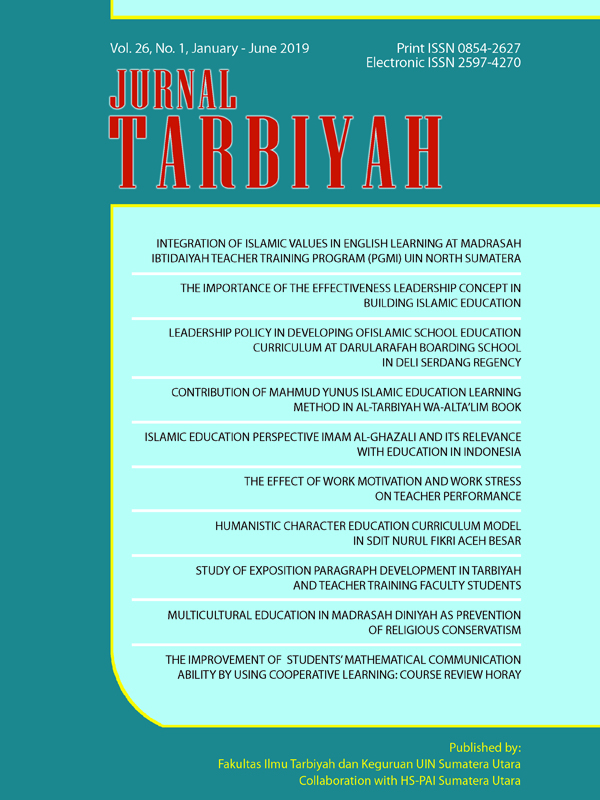
LEADERSHIP POLICY IN DEVELOPING OF ISLAMIC SCHOOL EDUCATION CURRICULUM AT DARULARAFAH BOARDING SCHOOL IN DELI SERDANG REGENCY
DOI:
https://doi.org/10.30829/tar.v26i1.422Abstrak
This study aimed to determine the process of formulating policies, implementing policies, performance, stakeholders support, and the policies of the boarding chairman in developing the Islamic school curriculum at the Darularafah Boarding School boarding school in Deli Serdang Regency. The data were obtained through interviews, observation, and documentation. The data analysis was done through data reduction, data presentation, and data verification. The results of this study were 1) The formulation of boarding school leaders' policies was carried out through annual meetings and deliberations attended by chairman, chiefs of fields, principals, teachers and communities to formulate five work programs related to the system of movement, organization and leadership, network, resources, and actions of service, 2) Implementation of formulation of the curriculumdevelopment program implemented at the Darularafah boarding school was carried out at the end of each year, then socialized to and through the prepared fields. 3) the performance of the implementation of the boarding schoolleadershippolicy was suited to its development as well as the boarding school’s needs, 4) Stakeholder supported in implementing the policies of the boarding school leadership that was very supportive in the internal environment, as well as from the external / communityReferensi
Abidin, Said Zainal. Kebijakan Publik. Jakarta: Suara Bebas, 2006.
Dimyanti dan Mudjiono. Belajar dan Pembelajaran. Jakarta: Penerbit Rineka Cipta, 1999.
Depdikbud. Kamus Besar Bahasa Indonesia. Jakarta: Balai Pustaka, 1995.
Fattah, Nanang. Analisis Kebijakan Pendidikan. Bandung: Remaja Rosdakarya, 2013.
Hamalik, Oemar. Kurikulum dan Pembelajaran. Jakarta: Bumi Aksara, 1995.
Hasbullah, H.M. Kebijakan Pendidikan: Dalam Persfektif Teori, Aplikasi, dan Kondisi Objektif Pendidikan di Indonesia. Jakarta: Raja Garfindo Persada, 2015.
______________. Kebijakan Pendidikan. Jakarta : PT. Raja Grafindo Persada, 2014.
Fatkuroji. Analisis Implementasi Kebijakan Pembelajaran Terpadu Terhadap Minat Konsumen Pendidikan: Studi SDIT Bina Amal dan SD Al-Azar 29BSB Semarang. Semarang: UIN Walisongo, 2012.
Jputt, Allen and J Fred Springer. Policy Research. New Jersey: Prentice Hall, 1990.
Masyhud Sulthon dan Moh. Khusnurdilo. Manajemen Pondok Pesantren. Jakarta: Diva Pustaka, 2005.
Pongtuluran, Aris. Kebijakan Organisasi dan Pengambilan Keputusan Manajerial. Jakarta: LPMP, 1995.
Mardianto. Media Pembelajaran Pendidikan Agama Islam. Medan: Institut Agama Islam Negeri, Fakultas Tarbiyah, 2010.
Musfah, Jejen. Peningkatan Kompetensi Guru. Jakarta: Kencana, 2015.
Nugroho, Riant. Public Policy: Teori Kebijakan, Analisis Kebijakan, Proses. Jakarta:Elex Media Komputindo, 2008.
Nurdin, Syarifuddin dan Basyiruddin Usman, Guru Profesional & Implementasi Kurikulum. Jakarta : PT. Intermasa, 2003.
Mahrus, Erwin, dan Moh Haitami Salim. Filsafat Pendidikan Islam. Pontianak: STAIN, 2009.
Peraturan pemerintah Republik Indonesia Nomor 19 Tahun 2005 tentang Standar Nasional pendidikan,Tambahan Lembaran Negara RI Nomor 4496, tt.
Robert, Bogdan dan Steven J. Taylor, Kualitatif Dasar-dasar Penelitian, Alih Bahasa A. Khozin Afandi. Surabaya: Usaha Nasional, 1993.
Sagala, Syaiful. Administrasi Pendidikan Kontemporer. Bandung: Alfabeta, 2008.
Sa’ud, Udin Syaefudin. Pengembangan Kebijakan dalam Kerangka Otonomi Daerah. Bandung: Alfabeta, 2011.
Sugiyono. Memahami Penelitian Kualitatif. Bandung: Alfabeta, 2014.
Sukmara, Dian. Implementasi Program Life Skill, Dalam Kurikulum Berbasis Kompetensi pada Jalur Sekolah. Bandung : Mughni Sejahtera, 2005.
Syafaruddin. Efektivitas Kebijakan Pendidikan. Jakarta: Rineka Cipta, 2008.
Veithzal, Rivai dan Murni Sylviana. Education Management. Bandung: Citapustaka Media Perintis, 2010.
Tilaar, H.A.R. Kekuasaan Dan Pendidikan.Jakarta: Rineka Cipta, 2009.
Tim Pengembang MKDP. Kurikulum dan Pembelajaran. Jakarta: Rajawali Pers, PT. Raja Grafindo Persada, 2012.
Unduhan
Diterbitkan
Terbitan
Bagian
Lisensi
Authors who publish with this journal agree to the following terms:
Authors are able to enter into separate, additional contractual arrangements for the non-exclusive distribution of the journal's published version of the work (e.g., post it to an institutional repository or publish it in a book), with an acknowledgement of its initial publication in this journal.
Authors are permitted and encouraged to post their work online (e.g., in institutional repositories or on their website) prior to and during the submission process, as it can lead to productive exchanges, as well as earlier and greater citation of published work (See The Effect of Open Access).
Jurnal Tarbiyah provides immediate open access to its content on the principle that making research freely available to the public supports a greater global exchange of knowledge. Jurnal Tarbiyah Open Access articles are distributed under this CC BY SA.