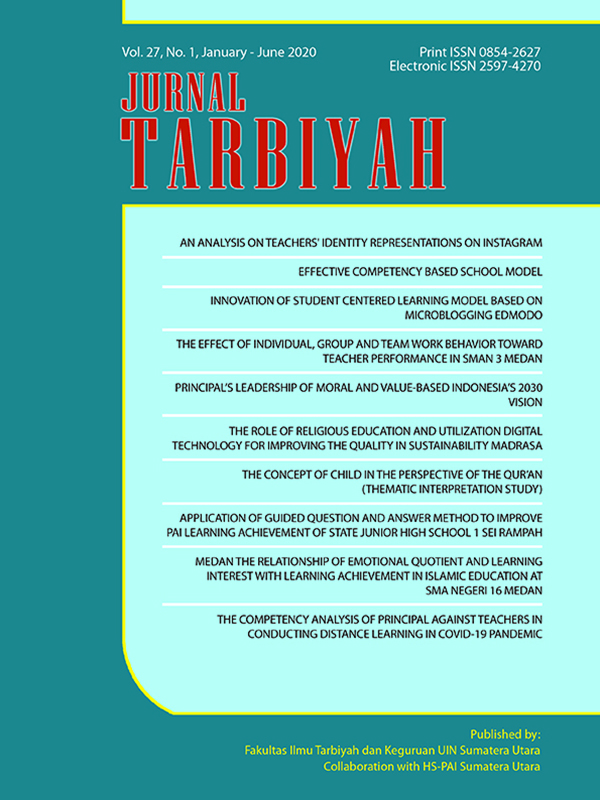
THE CONCEPT OF CHILD IN THE PERSPECTIVE OF THE QUR’AN (THEMATIC INTERPRETATION STUDY)
DOI:
https://doi.org/10.30829/tar.v27i1.685Abstrak
The revival of Islamic religion has formed a new atmosphere for the condition or fate of the children of Arabs. Islam forbids the killing of children through the prohibition of Allah, among others, contained in QS. Al-Isra/17: 31. Besides prohibits killing children, featuring the provisions of Islamic law that shows how important attention to and even how to look after children with a loving since before and after birth. The Qur’anic view of children globally formulated in the principle:"The children do not cause problems and suffering of parents and also vice versa" In the Qur’an, Allah says "Do not be a mother suffering difficulties because of his son and father do not have to suffer because of his son, and likewise heir duty.” Qur'an has serious concern about the child. This is evident from the various terms used in the Qur’an to show the meaning of the child as źurriyah, ibn, walad, sabiy, usbah, gulam, thifl, nasl, rabaib, and ad'iya '. As a review of the limitation, this study will analyze the concept of child in the perspective of the Qur'an (interpretation of thematic studies).Referensi
DAFTAR PUSTAKA
Abd al-Baqy, Fuad Muhammad, Al-Mu’jam al-Mufahras li Alfaz al-Qur’an al- Karim, Maktabah Dahlan: Indonesia, tt.
Abdul Mustakim, Kedudukan dan Hak-hak Anak dalam Perspektif al-Qur’an, (Artikel Jurnal Musawa, vol.4 No. 2, Juli-2006)
Abu al-Abbas, ‘Ali al-Fayyumi, Ahmad bin Muhammad, al-Mishbah al-Munir fi Garib Alquran Al-Karim
Al-Alusy, Sihabuddin Mahmud bin Abdullah al-Husain, Ruh al-Ma’ani fi Tafsir al- Qur’an al-Karim wa as-Saba’ al-Masani,http://www.altafsir.com,
Al-Asfihani, al-Ragib, Mufradat al-Faz al-Quran al-Karim, ed. Nadim Mar’asyili: Dar al-Fikri, Beirut, tt.
Dahlan, Abdul Aziz, et.al, Ensiklopedi Hukum Islam, Jakarta: Ikhtiar baru Vanhove, 1996
Al-Farmawy, Abd al-Hay, Al-Bidayah fi at-Tafsir al-Maudhu’I, Mesir, al-Maktabah al-Jumhuriyah, 1976.
Fat-hiyah Hasan Sulaiman, Tarbiyatu Al Thifli Baina al Madhi wa Al Hadhir, Mesir, Dar Al Syuruq, 1399 H/1979 M.
Ibn Manzur, Muhammad bin Mukram, lisan al-‘Arab, Dar Sadir, Beirut. tt.
Ibn Zakariya, Abu al-Husain Ahmad bin Faris, Mu’jam Maqayyis al-Lugah, Daar al-Fikr, Beirut, 1979.
Ibrahim Musthafa, al-Mu’jam al-Wasith, Dar an-Nasyr: Daar ad-Da’wah, tt
Instruksi Presiden Nomor 1 Tahun 1991 tentang Kompilasi Hukum Islam
Al-Munawiy, Abdurrauf, Muhammad, At_Ta’aarif, ed, Muhammad Ridhwan a- Dayyah, Dar al-Fikr, Beirut, Cet 1410 H.
Al-Razi, Abu ‘Abdullah Muhammad bin ‘Umar bin hasan bin Husain, Tafsir al- Kabir/mafatih al-Gaib, http://www.altafsir.com.
Saifullah, Problematika Anak dan Solusinya (Pendekatan Sadduzzara), (Artikel Jurnal Mimbar Hukum, Jakarta, Al-Hikmah dan DITBINBAPERA Islam No. 42 Tahun X 1999).
Shihab, M. Quraish, Tafsir Al-Misbah:Pesan, Kesan, dan Keserasian al-Qur’an, Jakarta, Lentera Hati, 2004
Sya’rawi, Muhammad Mutawalli, Tafsir as-Sya’rawi, http://adel-ebooks.mam9.com
At-Tabari, Muhammad bin Jarir bin Yazid bin Katsir bin Galib al-Amaliyy, Jami’ al- Bayan fi Ta’wil al-Qur’an, Muassasah ar-Risalah, tt .
At-Tabtaba’i, Tafsir Al-Mizan, http://www.shamela.ws/,
Tim Penyusun Kamus Pusat Pembinaan Dan Pengembangan Bahasa, Kamus Besar Bahasa Indonesia, cet-10; Jakarta: Balai Pustaka, 1999
Undang-undang Nomor 1 Tahun 1974, tentang Perkawinan
Undang-undang Nomor 23 Tahun 2002, tentang Perlindungan Anak.
Az-Zabidiy, Muhammad bin Muhammad bin Abd ar-Razzaq al-Husaini, Tajul ‘Arus min Jawahir al-Qamus, http://www.alwarraq.com.
Az-Zamakhsyari, Abu al-Qasim Amri bin Ahmad, al-Kassyaf, http://www.altafsir.com
Unduhan
Diterbitkan
Terbitan
Bagian
Lisensi
Authors who publish with this journal agree to the following terms:
Authors are able to enter into separate, additional contractual arrangements for the non-exclusive distribution of the journal's published version of the work (e.g., post it to an institutional repository or publish it in a book), with an acknowledgement of its initial publication in this journal.
Authors are permitted and encouraged to post their work online (e.g., in institutional repositories or on their website) prior to and during the submission process, as it can lead to productive exchanges, as well as earlier and greater citation of published work (See The Effect of Open Access).
Jurnal Tarbiyah provides immediate open access to its content on the principle that making research freely available to the public supports a greater global exchange of knowledge. Jurnal Tarbiyah Open Access articles are distributed under this CC BY SA.