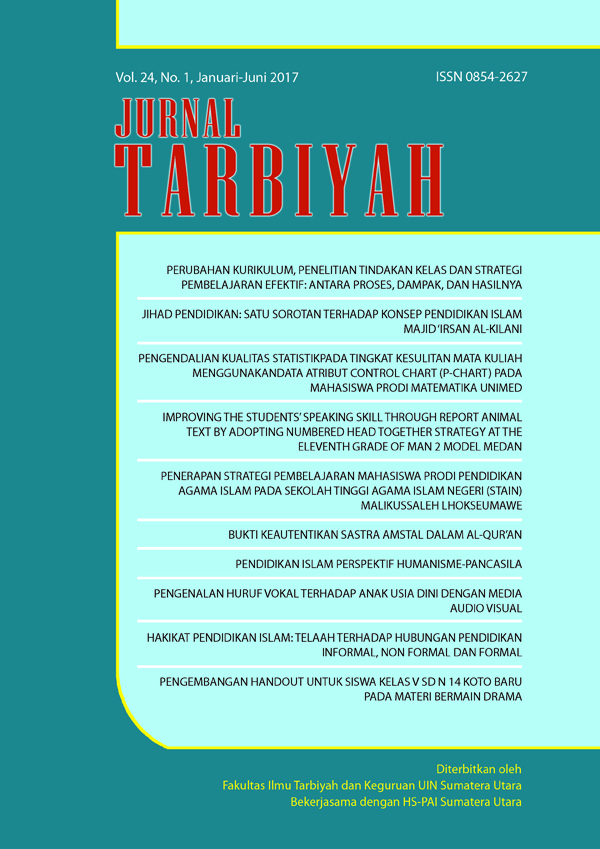
PERUBAHAN KURIKULUM, PENELITIAN TINDAKAN KELAS DAN STRATEGI PEMBELAJARAN EFEKTIF: ANTARA PROSES, DAMPAK, DAN HASILNYA
DOI:
https://doi.org/10.30829/tar.v24i1.123Abstrak
Abstract: Curriculum Changes, Class Action Research And Effective Teaching Strategies: The Process, Impact, And Results. Implementation of instructional development is inseparable from the curriculum is going to be the frame of the curriculum implementation in the educational process at the school level to classroom teaching and learning activities. Similarly for Islamic Education Curriculum. Curriculum change is not just a question of epistemological but also an administrative question. Teachers have an important role on the effectiveness of integrative curriculum goes often referred to as curriculum 2013. Class Action Research can be a vehicle for the implementation implicates teachers learn to teach in classroom activities. Effective teachers have a teaching strategy that is supported by subject matter mastery, lesson plans, and classroom management. Key Words: curriculum, Class Action Research, teaching strategy Abstrak: Perubahan Kurikulum, Penelitian Tindakan Kelas Dan Strategi Pembelajaran Efektif: Antara Proses, Dampak, Dan Hasilnya. Implementasi pengembangan pembelajaran tidak dapat dipisahkan dari kurikulum yang dijadikan sebagai kerangka implementasi kurikulum dalam proses pendidikan di sekolah pada level sekolah hingga kegiatan belajar mengajar di kelas. Demikian pula bagi Kurikulum Pendidikan Islam. Perubahan kurikulum bukan hanya persoalan epistemologis namun juga dapat merupakan persoalan administratif. Guru memiliki peran penting terhadap efektivitas berjalannya Kurikulum Integratif ini yang sering disebut juga sebagai Kurikulum 2013. Penelitian Tindakan Kelas dapat menjadi sebuah wahana bagi para guru untuk mengembangkan profesionalismenya sebagai seorang pendidik dan pengajar yang efektif. Guru-guru yang efektif mampu menyusun strategi pembelajaran yang didukung oleh penguasaan materi pelajaran, rencana pembelajaran, dan manajemen kelas. Kata Kunci: kurikulum, Penelitian Tindakan Kelas, strategi pembelajaranReferensi
Beyer, Barry K. (1985). "Teaching Thinking Skills" National Association of Secondary School Principals: January.
Beyer, Barry K. (1987). Practical Strategies for the Teaching of Thinking. Boston: Allyn and Bacon.
Blenkin, Geva M. dan Kelly, A. V. (1981). The Primary Curriculum. London: Harper & Row Ltd.
Gibb, J. R. (1978). Trust: A New View of Personal and Organizational Developoment. Los Angeles, CA: Guild of Tutors Press.
Hall, G. E., George, A. A., & Rutherford, W. L. (1977). Measuring Stages of Concern About the Innovation: A Manual for Use of SoC Questionnair Austin, TX: The University of Texas.
Hamalik, Oemar. (2007). Manajemen Pengembangan Kurikulum . Bandung: PT Remaja Rosda Karya.
Leithwood, K. A. dan Montgomery, D. J. (1980). Assumptions and Uses of A Procedure for Assessing Program Implementation. Paper presentedat the Annual Meeting of The American Educational Research Association, Boston.
Miller, John P. & Seller, Wayne. (1985). Curriculum: Perspective and Practice. New York & London: Longmans.
Ornstein, Allan C. (1990). Strategies for Effective Teaching. New York: HarperCollins Publishers.
Santrock, J.W. (2008). Edisi Kedua. Psikologi Pendidikan. Jakarta: Kencana.
Soeharto, Karti dkk. (1995). Teknologi Pembelajaran. Surabaya: Surabaya Intellectual Club.
Unduhan
Diterbitkan
Terbitan
Bagian
Lisensi
Authors who publish with this journal agree to the following terms:
Authors are able to enter into separate, additional contractual arrangements for the non-exclusive distribution of the journal's published version of the work (e.g., post it to an institutional repository or publish it in a book), with an acknowledgement of its initial publication in this journal.
Authors are permitted and encouraged to post their work online (e.g., in institutional repositories or on their website) prior to and during the submission process, as it can lead to productive exchanges, as well as earlier and greater citation of published work (See The Effect of Open Access).
Jurnal Tarbiyah provides immediate open access to its content on the principle that making research freely available to the public supports a greater global exchange of knowledge. Jurnal Tarbiyah Open Access articles are distributed under this CC BY SA.