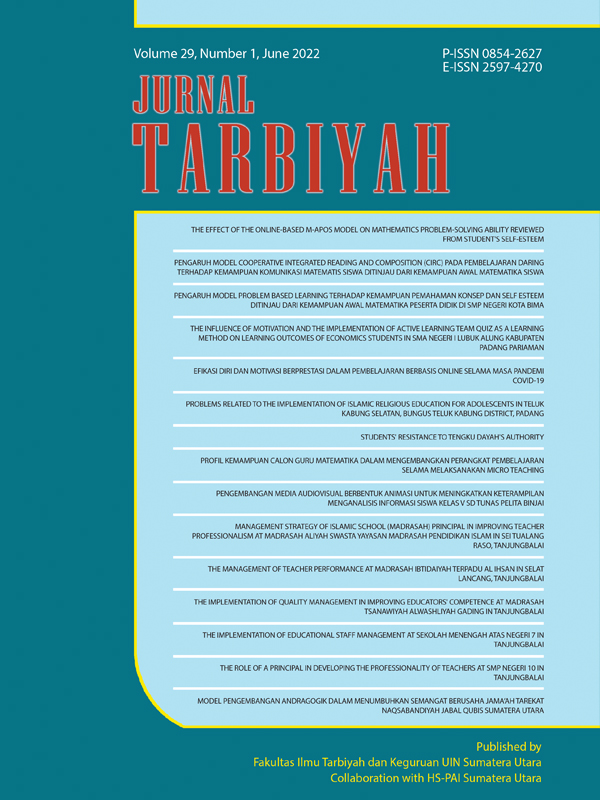
THE EFFECT OF THE ONLINE-BASED M-APOS MODEL ON MATHEMATICS PROBLEM-SOLVING ABILITY REVIEWED FROM STUDENT'S SELF-ESTEEM
DOI:
https://doi.org/10.30829/tar.v29i1.1266Abstrak
Mathematics is a difficult subject for most students, where students tend not to be able to solve problems on questions in the form of problem-solving such as description questions. Efforts can be made to increase student learning outcomes by applying the M-APOS learning model. This study investigates whether or not there is a significant effect of the M-APOS learning model on mathematical problem-solving abilities in terms of the self-esteem of East Jakarta Vocational School students Region II, 2021-2022 academic year. This study is an experimental study that compares the value of the experimental class using the M-APOS model with the value of the control class using the conventional model. The values are analyzed using the t-test, where the results of the t-test indicate thatReferensi
A. Jariah, N. A., Zulkardi, Z., & Hartono, Y. (2018). Penerapan Self-Esteem Dalam Pembelajaran Matematika Menggunakan Pendekatan Open-Ended. HISTOGRAM: Jurnal Pendidikan Matematika, 1(2), 105. https://doi.org/10.31100/histogram.v1i2.28
Dhawan, S. (2020). Online Learning: A Panacea in the Time of COVID-19 Crisis. Journal of Educational Technology Systems, 49(1), 5–22. https://doi.org/10.1177/0047239520934018
Eliza, W., Suyono, & Hakim, L. EL. (2018). Pengaruh Pendekatan M-APOS Terhadap Kemampuan Penalaran Matematis Siswa SMP Negeri di Kota Tangerang. Jurnal Riset Pendidikan Matematika Jakarta, 1(1), 31–38.
Fatah, A., Suryadi, D., Sabandar, J., & Turmudi. (2016). Open-ended approach: An effort in cultivating students’ mathematical creative thinking ability and self-esteem in mathematics. Journal on Mathematics Education, 7(1), 9–18. https://doi.org/10.22342/jme.7.1.2813.9-18
Happy, N., & Widjajanti, D. B. (2014). Keefektifan Pbl Ditinjau Dari Kemampuan Berpikir Kritis Dan Kreatif Matematis, Serta Self-Esteem Siswa Smp. Jurnal Riset Pendidikan Matematika, 1(1), 48. https://doi.org/10.21831/jrpm.v1i1.2663
Hartati, S. J. (2014). Design of Learning Model of Logic and Algorithms Based on APOS Theory. International Journal of Evaluation and Research in Education (IJERE), 3(2), 109–118. https://doi.org/10.11591/ijere.v3i2.5743
Irwan, -, Silfia, R., & Irwan, -. (2018). Validity of Mathematics Learning Devices Based on Quantum Teaching to Improve The Problem Solving Ability of Students Class XI Vocational School. 285(Icm2e), 196–199. https://doi.org/10.2991/icm2e-18.2018.63
Lahinda, Y., & Jailani, J. (2015). Analisis Proses Pemecahan Masalah Matematika Siswa Sekolah Menengah Pertama. Jurnal Riset Pendidikan Matematika, 2(1), 148. https://doi.org/10.21831/jrpm.v2i1.7157
Lassoued, Z., Alhendawi, M., & Bashitialshaaer, R. (2020). education sciences An Exploratory Study of the Obstacles for Achieving Quality in Distance Learning during the. Education Sciences, 10, 1–13.
Légeron, P. (1987). Self esteem. Soins. Psychiatrie, 13(79), 25–31.
Mandasari, S., Arnawa, I. M., & Atmazaki, -. (2018). Development of
Mathematics Lesson Equipment Based On M-APOS Model to Improve Creative Thinking Skill on Grade X Students at Senior High School. 285(Icm2e), 229–235. https://doi.org/10.2991/icm2e-18.2018.53
Mendadak, T., Besser, A., Flett, G. L., Zeigler-hill, V., Flett, G. L., & Zeigler-hill,
V. (2020). Beasiswa Pengajaran dan Pembelajaran dalam Psikologi Beradaptasi dengan Transisi Mendadak ke Pembelajaran Online.
Nella Kresma, E. (2014). Perbandingan Pembelajaran Konvensional Dan Pembelajaran Berbasis Masalah Terhadap Titik Jenuh Siswa Maupun Hasil Belajar Siswa Dalam Pembelajaran Matematika. Educatio Vitae, 1, 152–164.
Netriwati. (2016). Analisis Kemampuan Pemecahan Masalah Matetamatis Berdasarkan Teori Polya Ditinjau dari Pengetahuan Awal Mahasiswa IAIN Raden Intan Lampung. Jurnal Pendidikan Matematika, 7(9), 181–190.
Puspita Dewi, E. M. (2016). Jurnal Ilmiah Psikologi. Inquiry, 7(1), 231143.
Refnadi, R. (2018). Konsep self-esteem serta implikasinya pada siswa. Jurnal
EDUCATIO: Jurnal Pendidikan Indonesia, 4(1), 16.
https://doi.org/10.29210/120182133
Rizka A, Pinta Deniyanti Sampoerno, Pinta Deniyanti Sampoerno, & Aris Hadiyan Wijaksana. (2020). Pengaruh Model Pembelajaran M-APOS Berbantuan Portal Rumah Belajar terhadap Kemampuan Pemahaman Konsep Matematis Siswa di SMKN 26 Jakarta. Jurnal Riset Pembelajaran Matematika Sekolah, 4(1), 15–19. https://doi.org/10.21009/jrpms.041.03
Utami, R. W., & Wutsqa, D. U. (2017). Analisis Kemampuan Pemecahan Masalah Matematika dan Self-Efficacy Siswa SMP Negeri di Kabupaten Ciamis An Analysis of Mathematics Problem-solving Ability and Self- Efficacy Students of Junior High School in Ciamis Regency. 4(2), 166–175.
Unduhan
Diterbitkan
Terbitan
Bagian
Lisensi
Authors who publish with this journal agree to the following terms:
Authors are able to enter into separate, additional contractual arrangements for the non-exclusive distribution of the journal's published version of the work (e.g., post it to an institutional repository or publish it in a book), with an acknowledgement of its initial publication in this journal.
Authors are permitted and encouraged to post their work online (e.g., in institutional repositories or on their website) prior to and during the submission process, as it can lead to productive exchanges, as well as earlier and greater citation of published work (See The Effect of Open Access).
Jurnal Tarbiyah provides immediate open access to its content on the principle that making research freely available to the public supports a greater global exchange of knowledge. Jurnal Tarbiyah Open Access articles are distributed under this CC BY SA.