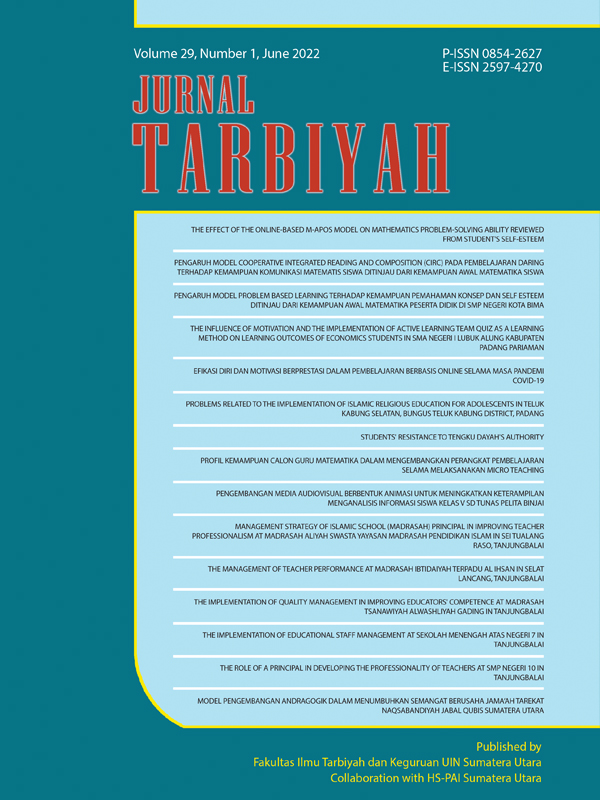
THE IMPLEMENTATION OF EDUCATIONAL STAFF MANAGEMENT AT SEKOLAH MENENGAH ATAS NEGERI 7 IN TANJUNGBALAI
DOI:
https://doi.org/10.30829/tar.v29i1.1382Abstrak
This study aims to describe the implementation of the management of educational staff at the SMA Negeri 7 in Tanjung Balai. This study used qualitative research methods and collected data by using interviews, study documentation, and observation. The findings of this study found that the appointment of educational staff includes a selection of administrative requirements, and psychology through filling out forms and other requirements. The findings indicate that the implementation went well, and it can be seen from educational staff who cooperated, communicated with each other well, and were placed according to their knowledge. Supervision has been carried out properly, as well as the form of supervision carried out by the principal as the education manager. In addition, there are several supporting factors such as employees who are disciplined, creative, and responsible, have supporting infrastructure, coaching that is often followed by employees, and inhibiting factors faced regarding the rapid development of the times so that systems and technology tools are always developing in the implementation of administration.Referensi
Abdullah, Nazaruddin. (2011). Al-Quran dan Manajemen Pendidikan. Bandung: Citapustaka Media Perintis.
Amiruddin, Wahyuli. (2010). Administrasi Pendidikan. Bandung: Citapustaka Media Perintis.
Asrul, Syafaruddin. (2014). Manajemen Kepengawasan Pendidikan. Bandung: Citapustaka Media.
Mulyasa (2005). Menjadi Kepala Sekolah Profesional. Bandung: PT Remaja Rosdakarya.
Sagala, Syaiful (2011). Kemampuan Profesional Guru dan Tenaga Kependidikan. Bandung: Alfabeta.
Salim, Syahrum. (2011). Metode Penelitian Kualitatif. Bandung: Citapustaka Media.
Syamsuddin, Udin. (2009). Perencanaan Pendidikan. Bandung: PT Remaja Rosdakarya.
Unduhan
Diterbitkan
Terbitan
Bagian
Lisensi
Authors who publish with this journal agree to the following terms:
Authors are able to enter into separate, additional contractual arrangements for the non-exclusive distribution of the journal's published version of the work (e.g., post it to an institutional repository or publish it in a book), with an acknowledgement of its initial publication in this journal.
Authors are permitted and encouraged to post their work online (e.g., in institutional repositories or on their website) prior to and during the submission process, as it can lead to productive exchanges, as well as earlier and greater citation of published work (See The Effect of Open Access).
Jurnal Tarbiyah provides immediate open access to its content on the principle that making research freely available to the public supports a greater global exchange of knowledge. Jurnal Tarbiyah Open Access articles are distributed under this CC BY SA.