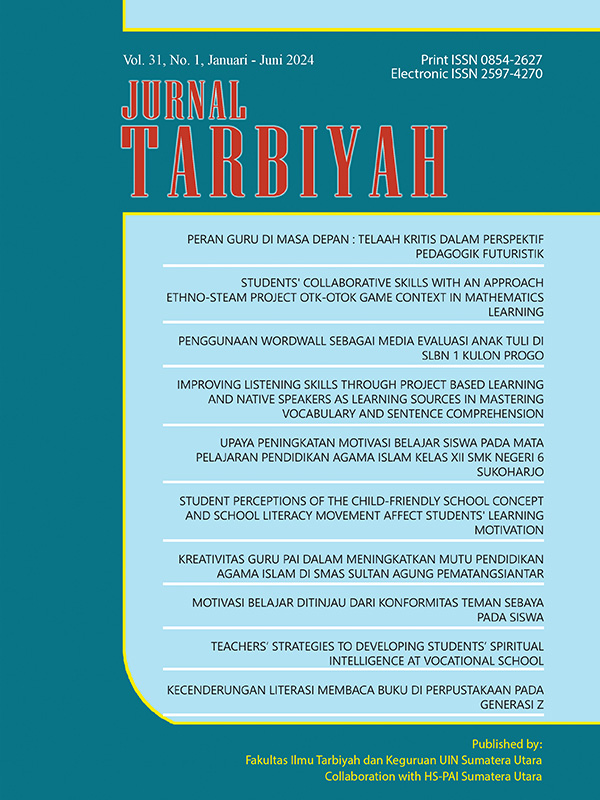
STUDENTS' COLLABORATIVE SKILLS WITH AN APPROACH ETHNO-STEAM PROJECT OTK-OTOK GAME CONTEXT IN MATHEMATICS LEARNING
DOI:
https://doi.org/10.30829/tar.v31i1.3059Abstrak
The traditional otok-otok game as a STEAM (Science, Technology, Engineering, Art, and Mathematics) based project can be used for mathematics learning. Research like this has never been done. The aim of this research is to describe students' collaborative skills through the Ethno-STEAM Project learning approach. The research subjects were 32 students with a pre-experimental research type with a one-shot case study design. Data regarding students' collaborative skills was obtained from student self-report questionnaires and data was strengthened through collaborative activity observation sheet forms. Data analysis uses descriptive statistics in the form of total scores and average percentages for each aspect or subdomain. The application of Ethno-STEAM Project learning in the context of otok-otok games produced results, namely that students' collaborative skills were in the high category 56%, in the medium category 31%, and in the low category 13%. Aspects of collaborative skills in the high category include motivation, contribution, problem-solving, time management, group dynamics, and interaction with group members. Aspects that need further development are in the categories of work quality, group support, readiness, roles, and reflection. The application of the Ethno-STEAM approach to the otok-otok game project in mathematics learning can be an alternative for developing students' collaborative skillsReferensi
Atun, S., & Latupeirisa, V. P. S. (2021). Science KIT Teaching Aid for the Earthquake in Improving Students’ Collaboration Skills and Creative Thinking in Junior High School. European Journal of Educational Research, 10(1), 187–197. https://doi.org/10.12973/EU-JER.10.1.187
Bakhrodin, B., Istiqomah, U., & Abdullah, A. A. (2019). Identifikasi Etnomatematika Pada Masjid Mataram Kotagede Yogyakarta. Jurnal Ilmiah Soulmath : Jurnal Edukasi Pendidikan Matematika, 7(2), 113–124. https://doi.org/10.25139/smj.v7i2.1921
Balqist, A., Jalmo, T., & Yolida, B. (2019). Penggunaan Model Discovery Learning Untuk Meningkatkan Keterampilan Kolaborasi dan Berpikir Tingkat Tinggi. Jurnal Bioterdidik, 7(2), 103–111. http://jurnal.fkip.unila.ac.id/index.php/JBT/article/download/17287/12315
Bender. (2012). Project-Based Learning: Differentiating Instruction for The 21St Century. California: Corwin.
Cholily, Y. M. (2020). Matematika dan Pembelajaran Berbasis STEAM. Prosiding Seminar Nasional Matematika Dan Pendidikan Matematika FKIP UMP 29 Agustus 2020, 1–5.
Condliffe, B., Quint, J., Visher, M. G., Bangser, M. R., Drohojowska, S., Saco, L., & Nelson, E. (2017). Project-based Learning: a Literature Review. Mdrc : Building Knowledge to Improve Social Policy, P-12 Education, 2. https://www.mdrc.org/publication/project-based-learning
Dahlberg, K. O. & K. (2009). Collaboration in Student Teaching: Introducing the Collaboration Self-Assessment Tool, Journal of Early Childhood Teacher Education. Evaluation & the Health Professions, 30(1), 37–38. https://doi.org/10.1080/10901020802668043
DeCoito, I. (2016). STEM Education in Canada: A Knowledge Synthesis. Canadian Journal of Science, Mathematics and Eechnology Education, 16(2), 114–128. https://doi.org/10.1080/14926156.2016.1166297
Falcione, S., Campbell, E., McCollum, B., Chamberlain, J., Macias, M., Morsch, L., & Pinder, C. (2019). Emergence of Different Perspectives of Success in Collaborative Learning. The Canadian Journal for the Scholarship of Teaching and Learning, 10(2).
https://doi.org/10.5206/cjsotl-rcacea.2019.2.8227
Fitriyani, R. V., Supeno, S., & Maryani, M. (2019). Pengaruh LKS Kolaboratif Pada Model Pembelajaran Berbasis Masalah Terhadap Keterampilan Pemecahan Masalah Fisika Siswa SMA. Berkala Ilmiah Pendidikan Fisika, 7(2), 71. https://doi.org/10.20527/bipf.v7i2.6026
Gialamas, S., Grigoropoulos, J. E., Pelonis, P., & Cherif, A. H. (2020). How Can Manifesting Leadership Skills Infused with Ethos, Empathy, and Compassion Better Prepare Students to Assume Leadership Roles? International Journal of Progressive Education, 16(February), 2020. https://doi.org/10.29329/ijpe.2020.
Hermawan, H., Siahaan, P., Suhendi, E., Kaniawati, I., Samsudin, A., Setyadin, A. H., & Hidayat, S. R. (2017). Desain Instrumen Rubrik Kemampuan Berkolaborasi Siswa SMP dalam Materi Pemantulan Cahaya. Jurnal Penelitian & Pengembangan Pendidikan Fisika, 3(2), 167–174. https://doi.org/10.21009/1.03207
Hidayat, A. (2018). Meta Analisis: Pentingnya Self Dan Peer Assesment Dalam Pembelajaran. Jurnal Basicedu, 2(1), 95–101. https://doi.org/10.31004/basicedu.v2i1.127
Isharyadi, R. (2018). Pengaruh Penerapan Pendekatan Kontekstual Terhadap Peningkatan Kemampuan Pemecahan Masalah Matematis Siswa. AKSIOMA: Jurnal Program Studi Pendidikan Matematika, 7(1), 48. https://doi.org/10.24127/ajpm.v7i1.1342
Kuswara, R., Hartuti, P., & Sinthia, R. (2018). Efektivitas Layanan Konseling Kelompok Teknik Modelling Dalam Membentuk Keterampilan Kepemimpinan Siswa. Consilia : Jurnal Ilmiah Bimbingan Dan Konseling, 1(2), 39–48. https://doi.org/10.33369/consilia.1.2.39-48
Lee, D., Huh, Y., & Reigeluth, C. M. (2015). Collaboration, intragroup conflict, and social skills in project-based learning. Instructional Science, 43(5), 561–590. http://www.jstor.org/stable/43575307
Listiyani, L. R. (2018). Implementasi Model Pembelajaran Inkuiri Berbasis Refleksi Kelompok pada Materi Reaksi Redoks. Jipva, 2, 58. https://doi.org/10.31331/jipva.v2i1.576
Mesiono, Arsyad Junaidi, Nasution Sakholid, Susanti Eka, & Daulay Hamidah Sholihatul. (2017). Jurnal Tarbiyah. Tarbiyah, 24(Juli-Desember 2017), 351–370. http://jurnaltarbiyah.uinsu.ac.id/index.php/tarbiyah/article/view/229/217
Mu’Minah, I. H., & Aripin, I. (2019). Implementasi Stem Dalam Pembelajaran Abad 21. Prosiding Seminar Nasional Pendidikan, 1(2012), 1496. https://prosiding.unma.ac.id/index.php/semnasfkip/article/view/219
Norhaqikah, M. K. dan, & Kamisah Osman. (2017). STEM-21CS Module : Fostering 21st Century Skills through Integrated STEM. K-12 STEM Education, 3(3), 225–233.
Primadhini, A. F. (2021). Analisis Kepercayaan Diri Siswa Kelas VIII Pada Pembelajaran Matematika di Tengah Pandemi COVID-19. Jurnal Cendekia : Jurnal Pendidikan Matematika, 5(3), 2294–2301. https://doi.org/10.31004/cendekia.v5i3.751
Prodromou, T., & Frederiksen, N. (2018). The Effects of Mathematics Anxiety on Primary Students. Mathematics Education Research Group of Australasia, 639–646.
Qomaria, N., & Wulandari, A. Y. R. (2022). Pengembangan Keterampilan Kolaboratif Siswa Melalui Pembelajaran Dengan Pendekatan Ethno-Steam Project Konteks Pesapean. AKSIOMA: Jurnal Program Studi Pendidikan Matematika, 11(2), 1306. https://doi.org/10.24127/ajpm.v11i2.4586
Rizkiyah, Z. R., Hariyadi, S., & Novenda, I. (2020). The Influence of Project Based Learning Models on Science Technology, Engineering and Mathematics Approach to Collaborative Skills and Learning Results of Student. ScienceEdu, 3(2), 1–6. https://jurnal.unej.ac.id/index.php/S%0Acedu/article/view/16589
Saenab, S., Yunus, S. R., & Husain, H. (2019). Pengaruh Penggunaan Model Project Based Learning Terhadap Keterampilan Kolaborasi Mahasiswa Pendidikan IPA. Biosel: Biology Science and Education, 8(1), 29. https://doi.org/10.33477/bs.v8i1.844
Safarini, D. (2019). Developing students’ collaboration skills through project-based learning in statistics. Journal of Physics: Conference Series, 1265(1). https://doi.org/10.1088/1742-6596/1265/1/012011
Sumarni, W., & Kadarwati, S. (2020). Ethno-stem project-based learning: Its impact to critical and creative thinking skills. Jurnal Pendidikan IPA Indonesia, 9(1), 11–21. https://doi.org/10.15294/jpii.v9i1.21754
Triana, D., Anggraito, Y. U., & Ridlo, S. (2020). Effectiveness of Environmental Change Learning Tools Based on STEM-PjBL Towards 4C Skills of Students. Jise, 9(2), 181–187. http://journal.unnes.ac.id/sju/index.php/jise
Ulhusna, M., Putri, S. D., & Zakirman, Z. (2020). Permainan Ludo untuk Meningkatkan Keterampilan Kolaborasi Siswa dalam Pembelajaran Matematika. International Journal of Elementary Education, 4(2), 130. https://doi.org/10.23887/ijee.v4i2.23050
Ummah, S. K., Inam, A., & Azmi, R. D. (2019). Creating manipulatives: Improving students’ creativity through project-based learning. Journal on Mathematics Education, 10(1), 93–102. https://doi.org/10.22342/jme.10.1.5093.93-102
Uziak, J. (2016). A project-based learning approach in an engineering curriculum. Global Journal of Engineering Education, 18(2), 119–123.
Widarwati, D., Utaminingsih, S., & Murtono. (2021). STEAM (Science Technology Egineering Art Mathematic) Based Module for Building Student Soft Skill. Journal of Physics: Conference Series, 1823(1). https://doi.org/10.1088/1742-6596/1823/1/012106
Yakman, G., & Lee, H. (2012). Exploring the Exemplary STEAM Education in the U.S. as a Practical Educational Framework for Korea. Journal of The Korean Association For Science Education, 32(6), 1072–1086. https://doi.org/10.14697/jkase.2012.32.6.1072
Yaqin, M. A., Indriwati, S. E., & Susilo, H. (2018). Think-pair-square learning: Improving student’s collaborative skills and cognitive learning outcome on animal diversity course. JPBI (Jurnal Pendidikan Biologi Indonesia), 4(2), 135–142. https://doi.org/10.22219/jpbi.v4i2.5514
Yuntiaji, D. A., Lukman, H. S., & Imswatama, A. (2020). Digital Worksheet Design Based of STEAM to Develop Students’ Problem Solving Skill. Mathematics Education Journal, 4(2), 137–146. https://doi.org/10.22219/mej.v4i2.13313
Yusuff, K. B. (2015). Does self-reflection and peer-assessment improve Saudi pharmacy students’ academic performance and metacognitive skills? Saudi Pharmaceutical Journal, 23(3), 266–275. https://doi.org/10.1016/j.jsps.2014.11.018
Zubaidah, S. (2019). STEAM (science, technology, engineering, arts, and mathematics): Pembelajaran untuk memberdayakan keterampilan abad ke-21 [STEAM (Science, Technology, Engineering, Arts, and Mathematics): Learning to Empower 21st Century Skills]. Seminar Nasional Matematika Dan Sains, September, 1–18.
Unduhan
Diterbitkan
Terbitan
Bagian
Lisensi
Authors who publish with this journal agree to the following terms:
Authors are able to enter into separate, additional contractual arrangements for the non-exclusive distribution of the journal's published version of the work (e.g., post it to an institutional repository or publish it in a book), with an acknowledgement of its initial publication in this journal.
Authors are permitted and encouraged to post their work online (e.g., in institutional repositories or on their website) prior to and during the submission process, as it can lead to productive exchanges, as well as earlier and greater citation of published work (See The Effect of Open Access).
Jurnal Tarbiyah provides immediate open access to its content on the principle that making research freely available to the public supports a greater global exchange of knowledge. Jurnal Tarbiyah Open Access articles are distributed under this CC BY SA.