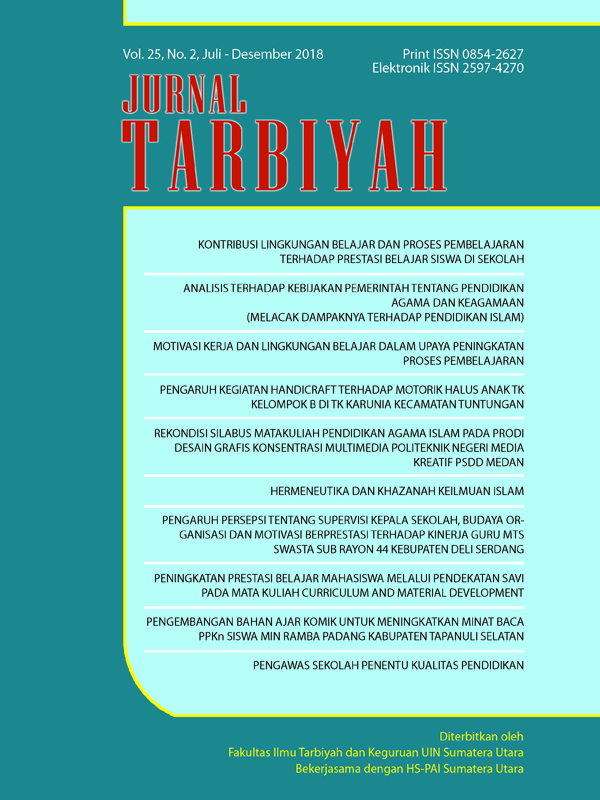
REKONDISI SILABUS MATAKULIAH PENDIDIKAN AGAMA ISLAM PADA PRODI DESAIN GRAFIS KONSENTRASI MULTIMEDIA POLITEKNIK NEGERI MEDIA KREATIF PSDD MEDAN
DOI:
https://doi.org/10.30829/tar.v25i2.315Abstrak
In the process of making the learning syllabus is done by using an analysis of the vision and mission of the educational institutions that correlate to the moral conditions of students and look at the needs in the world of work, the process of making instructional materials is also carried out from a combination of the elaboration of the entire subject syllabus and the needs of the Industrial world followed by the development of activities religion that leads student behavior to good character. Organizational elements of students are also involved in determining the direction of moral change better, because they are in the organizational organ in the institution both in the concept and order of the campus administration, and good in dealing with the world of work and industry. Good work is seen from good character and attitude.Referensi
Baseeng, dan Bayu Hikmat Purwana. 2015. Aktualisasi Nilai-Nilai Dasar Profesi Pegawai Negeri Sipil: Modul Pendidikan dan Pelatihan Prajabatan Golongan III. Jakarta: Lembaga Administrasi Negara
Budiastuti, E., & Boga, J. P. T. (2010, December). Strategi Penerapan Pendidikan Karakter pada Pembelajaran Praktek Busana. In Makalah disajikan pada Seminar Nasional.
Candra Santoso, A. Strategi Pemasaran dengan Mengurangi Komplain Konsumen pada UKM Skd. In Seminar Nasional Multi Disiplin Ilmu Unisbank 2017. Stikubank University.
Politeknik Negeri Media Kreatif. 2010. Prospektus PoliMedia. Jakarta: PoliMedia Printing
Suhid, A. (2008). Pendidikan akhlak dan adab Islam. Utusan Publications. Kuala Lumpur.
Tabi’in, A. (2008). Konsep etika peserta didik dalam pendidikan Islam menurut KHM Hasyim Asy’ari: Studi kitab adab al-’alim wa al-muta’allim (Doctoral dissertation, Universitas Islam Negeri Maulana Malik Ibrahim).
Unduhan
File Tambahan
Diterbitkan
Terbitan
Bagian
Lisensi
Authors who publish with this journal agree to the following terms:
Authors are able to enter into separate, additional contractual arrangements for the non-exclusive distribution of the journal's published version of the work (e.g., post it to an institutional repository or publish it in a book), with an acknowledgement of its initial publication in this journal.
Authors are permitted and encouraged to post their work online (e.g., in institutional repositories or on their website) prior to and during the submission process, as it can lead to productive exchanges, as well as earlier and greater citation of published work (See The Effect of Open Access).
Jurnal Tarbiyah provides immediate open access to its content on the principle that making research freely available to the public supports a greater global exchange of knowledge. Jurnal Tarbiyah Open Access articles are distributed under this CC BY SA.