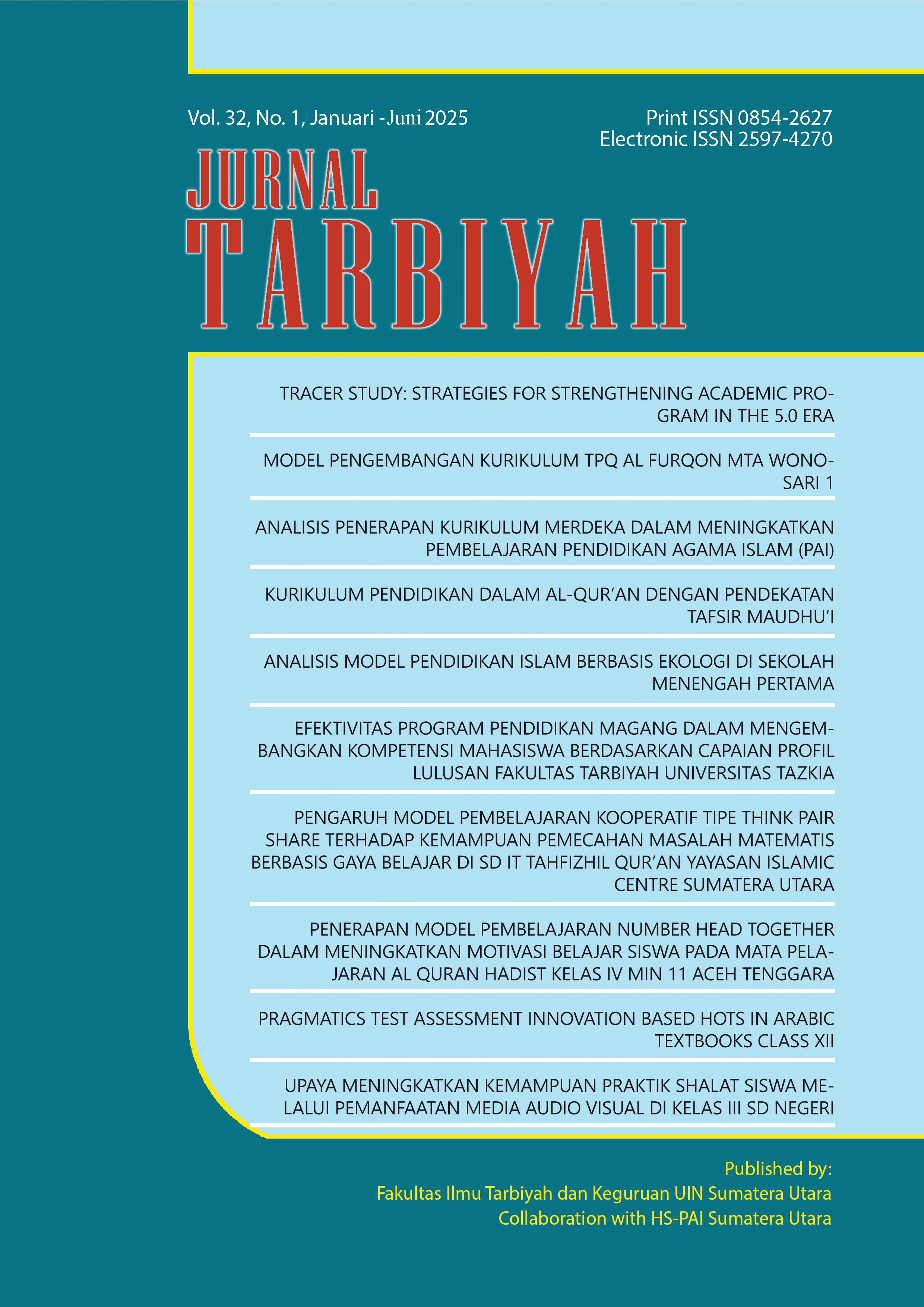
TRACER STUDY: STRATEGIES FOR STRENGTHENING ACADEMIC PROGRAM IN THE 5.0 ERA
DOI:
https://doi.org/10.30829/tar.v31i1.4336Abstrak
As technology evolves through the 4.0 Industrial Revolution and the 5.0 Era, higher education institutions must adapt to remain relevant. Tracer Studies are crucial for tracking alumni career paths and assessing the effectiveness of academic programs, ensuring that curricula align with industry needs. Without regular updates based on alumni data, graduates may experience skills mismatches, which can negatively impact employability and hinder institutional growth, leading to decreased enrolment, financial difficulties, and challenges in attracting faculty. UIN Ar-Raniry Banda Aceh, with over 55,000 graduates, faces challenges due to the lack of a reliable alumni database. Fragmented data on alumni career paths hinders effective engagement and development. Tracer Studies can address this by providing valuable insights into alumni outcomes and identifying gaps in curricula. This study is also aligned with Indonesia’s Eight Key Performance Indicators, focusing on alumni employability and professional success. For UIN Ar-Raniry, it is critical that alumni qualifications meet the evolving demands of the job market, especially in science-related fields. Additionally, Tracer Studies help institutions meet accreditation requirements from Indonesia's National Accreditation Board for Higher Education, ensuring academic programs remain relevant and effective. To address these issues, from January to June 2024, UIN conducted a tracer study on alumni from 2021, 2022, and 2023 in Aceh Besar, Banda Aceh, and Sabang. Data were collected through online questionnaires, blended interviews, and focus group discussions (FGD). The study found that out of 460 respondents, 102 alumni are employed, with 12 being entrepreneurs. Notably, 76% found jobs within six months, although 33.5% were not actively seeking employment. Alumni users expressed high satisfaction with alumni leadership skills and integrity, despite challenges like limited job openings and networking opportunities. Ultimately, this study is essential for evaluating how well institutions meet labor market demands, refining curricula, and strengthening alumni relations. By conducting regular tracer studies, UIN Ar-Raniry Banda Aceh can ensure its graduates are equipped with the necessary skills, improve alumni engagement, and contribute more effectively to regional and national development.Referensi
Alan Wilson, Valarie A. Zeinthaml, Mary Jo Bitner, & Dwayne D. Gremler. (2012). Services Marketing: Integrating Customer Focus Across the Firm. McGraw Hill Education.
Aldoory, L., & Toth, E. (2004). Leadership and Gender in Public Relations: Perceived Effectiveness of Transformational and Transactional Leadership Styles. Journal of Public Relations Research, 16(2), 157–183. https://doi.org/10.1207/s1532754xjprr1602_2
Allison Fine, & Beth Kanter. (2018, March 18). Using Technology to Make Work More Human. Harvard Business Review. https://hbr.org/2022/03/using-technology-to-make-work-more-human
Andres Diaz Lantada. (2020). Engineering Education 5.0: Continuously Evolving Engineering Education. International Journal of Engineering Education, 36(6), 1814–1832.
Burke, S., & Diazgranados, D. (2011). Team leadership: A review and look ahead. https://www.researchgate.net/publication/291048177
Craig E. Johnson, & Michael Z. Hackman. (2013). Leadership: A Communication Perspective. Waveland Press.
David Kirp. (2019). The College Dropout Scandal. Oxfors University Press.
Davis, M. H. (1994). Empathy: A Social Psychological Approach. Westview Press.
Hackman, J. R., & Oldham, G. R. (1976). Motivation Through the Design of Work: Test of a Theory. Organizational Behavior and Human Performance, 16(2), 250–279. https://doi.org/10.1016/0030-5073(76)90016-7
Herald Schomburg. (2016). Carrying Out Tracer Studies: Guid To Anticipating and Matching Skills and Jobs. International Labour Office.
Hirschi, A., Herrmann, A., & Keller, A. C. (2015). Career adaptivity, adaptability, and adapting: A conceptual and empirical investigation. Journal of Vocational Behavior, 87, 1–10. https://doi.org/10.1016/j.jvb.2014.11.008
Imam Gunawan. (2013). Qualitative Research Methods, Theory and Practice. Bumi Aksara.
Jaja Suteja. (2020). Menyoal Peran dan Eksistensi Alumni Perguruan Tinggi. https://www.researchgate.net/publication/342519881
Jones, T. M. (1991). Ethical Decision Making by Individuals in Organizations: An Issue-Contingent Model. The Academy of Management Review, 16(2), 366. https://doi.org/10.2307/258867
Julia T. Wood. (1997). Communitacion in Our Lives. Wadworth.
Kemdikbud. (2020). Peraturan Menteri Pendidikan dan Kebudayaan Nomor 22 Tahun 2020 Tentang Rencana Strategis Kementerian Pendidikan dan Kebudayaan Tahun 2020-2024.
Knight, J., & De Wit, H. (2018). Internationalization of Higher Education: Past and Future. International Higher Education, 1(95), 2–4. https://doi.org/10.6017/ihe.2018.95.10715
Komariah, Aan Satori, & Diam’an. (2011). Qualitative Research Methods. Alfabeta.
Lexy J Moleong. (2018). Qualitative Research Methodology. Remaja Rosdakarya.
Linda K. Trevino, & Katherine A. Nelson. (2019). Managing Business Ethics: Straight Talk About Gow to do it Right. In Personnel Psychology (7th ed., Issue 4). Wiley. https://doi.org/10.1111/peps.12360
Marciniak, J., Johnston, C. S., Steiner, R. S., & Hirschi, A. (2022). Career Preparedness Among Adolescents: A Review of Key Components and Directions for Future Research. Journal of Career Development, 49(1), 18–40. https://doi.org/10.1177/0894845320943951
McCall, M. W., Lombardo, M. M., Morrison, & Ann M. (1998). The Lessons of Experience : How Successful Executives Develop on the Job. Lexington Books.
Noddings, N. (2003). Caring: A feminine Approach to Ethics and Moral Education. University of California Press.
Peter F. Drucker. (2006). The Effective Executive. Harper Collins Publishers.
Peter G. Northouse. (2013). Leadership Theory and Practice. Sage Publications.
Poell, R. (2014). Workplace Learning Theories and Practices. In Human Resource Development (pp. 19–32). Macmillan Education UK. https://doi.org/10.1007/978-1-137-36133-2_2
Reason, J. (1990). Human Error. Cambridge University Press. https://doi.org/10.1017/CBO9781139062367
Ridwan Abdullah Sani. (2014). Pembelajaran Saintifik Untuk Impementasi Kurikulum 2013. Bumi Aksara.
Ron Dearing. (1997). Higher Education in the Learning Society. https://web.archive.org/web/20190105025759/http://www.leeds.ac.uk/educol/ncihe/
Sadeghi, A., Akmaliah, Z., & Pihie, L. (2012). Transformational Leadership and Its Predictive Effects on Leadership Effectiveness. International Journal of Business and Social Science, 3(7). www.ijbssnet.com
Salas, E., & Cannon-Bowers, J. A. (2001). Teamwork and Team Training. In International Encyclopedia of the Social & Behavioral Sciences (pp. 15487–15492). Elsevier. https://doi.org/10.1016/B0-08-043076-7/01436-4
Scherman, V., Howie, S. J., & Bosker, R. J. (2011). Constructing Benchmarks for Monitoring Purposes: Evidence From South Africa. Educational Research and Evaluation, 17(6), 511–525. https://doi.org/10.1080/13803611.2011.632663
Steve Taplin. (2022, May 27). Using Technology To Reduce Employee Turnover. Forbes Technology Council. https://www.forbes.com/councils/forbestechcouncil/2022/05/27/using-technology-to-reduce-employee-turnover/
Sugiyono. (2011). Metode Penelitian Kualitatif dan R & D. Alfabeta.
Suharsimi Arikunto. (2006). Prosedur Penelitian: Suatu Pendekatan Praktik. Rineka Cipta.
Thomas Bieger. (2024, January 29). The Role of Alumni in the Development of their University. Global Focus. https://globalfocusmagazine.com/the-role-of-alumni-in-the-development-of-their-university/
Toquero, C. M. D., & Ulanday, D. M. P. (2021). University Graduates’ Assessment of the Relevance of the Curriculum to the Labor Market in the Philippines. International Research in Education, 9(1), 19. https://doi.org/10.5296/ire.v9i1.17421
Tuckman, B. W. (1965). Developmental sequence in small groups. Psychological Bulletin, 63(6), 384–399. https://doi.org/10.1037/h0022100
Widyaningrum, A. Y. (2021). Kajian Tentang Komunitas Virtual: Kesempatan dan Tantangan Kajian di Bidang Ilmu Komunikasi. Jurnal Komunikatif, 10(2), 141–152. https://doi.org/10.33508/jk.v10i2.3457
World Economic Forum. (2023). Future of Jobs Report 2023. https://www3.weforum.org/docs/WEF_Future_of_Jobs_2023.pdf
Yukl, & Gary. (2013). Leadership in Organizatios (8th ed.). Pearson.
Unduhan
Diterbitkan
Terbitan
Bagian
Lisensi
Authors who publish with this journal agree to the following terms:
Authors are able to enter into separate, additional contractual arrangements for the non-exclusive distribution of the journal's published version of the work (e.g., post it to an institutional repository or publish it in a book), with an acknowledgement of its initial publication in this journal.
Authors are permitted and encouraged to post their work online (e.g., in institutional repositories or on their website) prior to and during the submission process, as it can lead to productive exchanges, as well as earlier and greater citation of published work (See The Effect of Open Access).
Jurnal Tarbiyah provides immediate open access to its content on the principle that making research freely available to the public supports a greater global exchange of knowledge. Jurnal Tarbiyah Open Access articles are distributed under this CC BY SA.